
animal cell
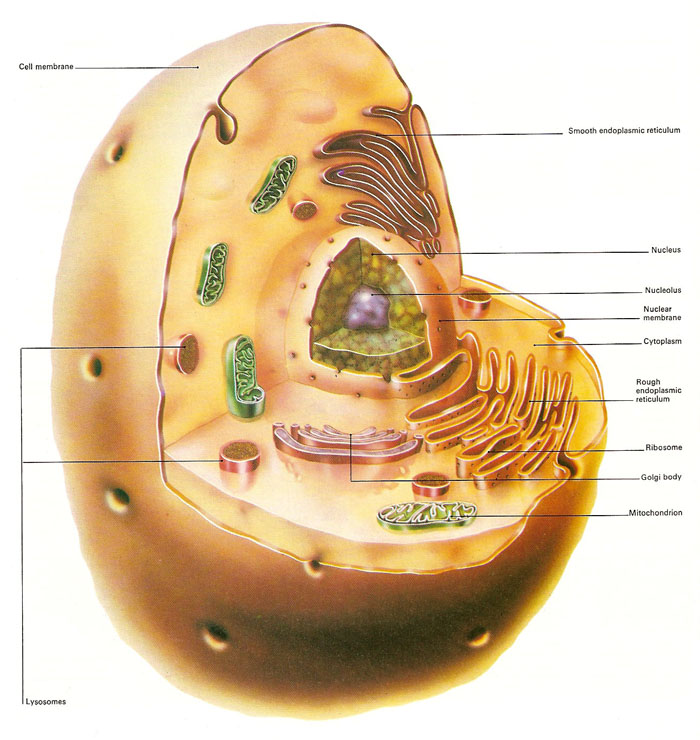
Like all eukaryotic cells, the cells of animals contain a variety of membrane-bounded organelles. These include:
Animal cells are distinct from other eukaryotes, most notably plant cells, however, in that they lack cell walls and chloroplasts, and they have smaller vacuoles.
Animal cells are all built to the same basic pattern. The nucleus is a membrane-bounded sac containing the genetic material of the cell. The genetic information is coded for in DNA (deoxyribonucleic acid). The nuclear membrane is perforated by pores that are important in controlling the exchange of substances between the nucleus and cytoplasm.
The cytoplasm contains numerous organelles. Prominent are the mitochondria, sausage-shaped bodies that are responsible for energy production. Scattered in the cytoplasm are several multi-layered membrane systems: the smooth endoplasmic reticulum, the rough endoplasmic reticulum, and the Golgi apparatus (or Golgi body). The smooth endoplasmic reticulum is concerned with the manufacture of lipids molecules while the rough endoplasmic reticulum manufactures proteins destined for export from the cell. The granular nature of the rough endoplasmic reticulum is created by the presence of globular ribosomes on the surface of its membranes and it is on the ribosomes that proteins are assembled. The Golgi apparatus, among other things, modifies some of these proteins. Sacs of enzymes, called lysosomes, are concerned with breaking down some of the large molecules that enter the cell.

