
Echo
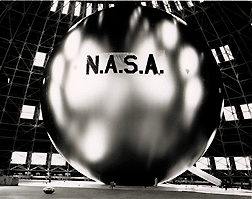
The Echo satellites were the world's first passive communications satellites. Each Echo spacecraft was a large aluminized Mylar balloon, inflated in orbit, which provided a reflective surface so that two-way voice signals could be bounced from ground stations on the west and east coasts of the United States.
Following the failure of the launch vehicle carrying Echo 1, Echo 1A (commonly referred to as Echo 1) was placed in orbit and used to redirect transcontinental and intercontinental telephone, radio, and television signals. Its success proved that microwave transmission to and from satellites in space was possible and demonstrated the promise of communications satellites. Also, because of its large area-to-mass ratio, it provided data for the calculation of atmospheric density and solar pressure. With a diameter of 30.5 meters, Echo 1A was visible to the unaided eye over most of the Earth and brighter than most stars. The 41.1-meter-diameter Echo 2 – the first joint American/Soviet collaboration in space – continued the passive communications experiments, enabled an investigation of the dynamics of large spacecraft, and was used for global geometric geodesy.
Although NASA abandoned passive communications systems in favor of active satellites following Echo 2, the Echo program demonstrated several ground station and tracking technologies that would be used by active systems.
| spacecraft | launch date | launch vehicle | launch site | orbit | mass (kg) |
| Echo 1 | May 13, 1960 | Delta | Cape Canaveral | failed to reach orbit | 56 |
| Echo 1A | Aug 12, 1960 | Delta | Cape Canaveral | 966 × 2,157 km × 47.3° | 76 |
| Echo 2 | Jan 25, 1964 | Thor-Agena B | Vandenberg | 1,030 × 1,315 km × 81.5° | 256 |

