
Envisat
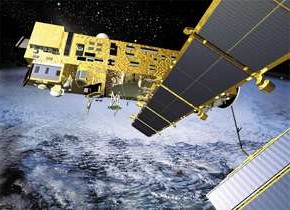
Envisat is the largest and most powerful Earth observation satellite ever built by the European Space Agency; it is a successor to ESA's ERS remote sensing satellites ERS-1 and ERS-2. Envisat was launched on March 1, 2002 aboard an Ariane 5 into a sun-synchronous orbit at a height of 790 kilometers (±10 kilometers). It orbits Earth in about 101 minutes with a repeat cycle of 35 days. Envisat carries an array of nine Earth-observation instruments that gather information about the Earth (land, water, ice, and atmosphere):
· ASAR (Advanced Synthetic Aperture Radar) can detect changes in surface
heights with sub-millimeter precision
· MERIS (MEdium Resolution Imaging Spectrometer) produces two-dimensional
images using a 15-band spectrometer
· AATSR (Advanced Along Track Scanning Radiometer) can measure the temperature
of the sea surface
· RA-2 (Radar Altimeter 2) is a dual-frequency nadir pointing radar
operating in the S band and Ku bands, used for measuring ocean topography,
map/monitor sea ice and measure land heights
· MWR (Microwave Radiometer) for measuring water vapor in the atmosphere
and give corrections for the altimeter
· DORIS (Doppler Orbitography and Radiopositioning Integrated by Satellite)
for orbit determination to within 10 cm or less
· GOMOS (Global Ozone Monitoring by Occultation of Stars) looks to stars
as they descend through the Earth's atmosphere and change color, which
also tells a lot about the presence of gases such as ozone, and allows
for the first time a space-based measurement of the vertical distribution
of these trace gases
· MIPAS (Michelson Interferometer for Passive Atmospheric Sounding)
is a spectrometer
· SCIAMACHY (SCanning Imaging Absorption SpectroMeter for Atmospheric
CHartographY) compares light coming from the Sun to light reflected
by the Earth, which provides information on the atmosphere through which
the earth-reflected light has passed

