
electric polarization
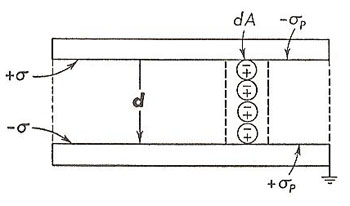
Electric polarization in a charged parallel-plate capacitor.
Electric polarization is the extent to which polar molecules have been induced in a dielectric, or in which permanent polar molecules have become aligned under the action of an external electric field. Electric polarization, P, is defined as the electric moment per unit volume. Thus,
P = dp/dv
Let us consider, as an example of polarization, the dielectric that is between the plates of a charged parallel-plate capacitor (see diagram). Throughout the body of the dielectric the charges on adjacent ends of polar molecules neutralize one another. At both the upper and lower boundaries of the dielectric, however, ends of polar molecules are exposed. Let the surface density of these exposed charges be σP. Consider specifically a tube of the dielectric, of cross-sectional area dA, extending from one capacitor plate to the other. Because the charges at the two ends are - σP dA and + σP dA, respectively, the dipole moment of this tube of dielectric is
dp = (σP dA)d
Consequently, in keeping with the definition of polarization,
P = dp/dv = dp/(volume of tube of dielectric) = (σP dA)d/(dA)d
or
P = σP
This presupposes, of course, that polarization throughout the dielectric is uniform, in which case the only unneutralized charges are those located at the surfaces of the dielectric. The polarization is then equal in magnitude to the charge per unit area on the surface of the dielectric.
For isotropic dielectrics (those whose electrical properties are identical in all directions), the polarization that occurs under the action of an electric field has the same direction as the field. Also, the degree of polarization is a function of the strength of the field. This dependence is expressed as
P = χeε0E
where χe, the electric susceptibility of the material, is a dimensionless quantity. For most isotropic dielectrics χe is constant except for very strong fields.
For anisotropic dielectrics, P and E are normally not parallel. Although their relationship is still expressed by the final equation above, the susceptibility is no longer a scalar, as for isotropic materials, but is instead a tensor.

