
Holmberg, Erik Bertil (1908–2000)
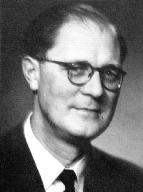
Erik Holmberg was a Swedish astronomer known for his studies of external galaxies. In 1941 he published the results of a remarkable simulation to study the effects of interacting galaxies. His experiment consisted of an array of light bulbs to represent, by their location, the stellar distribution in a galaxy and, by their brightness, the local strength of gravity. Using photocells he measured the simulated gravitational forces as, step by step, two galaxies passed close to each other. One of his conclusions was that interacting galaxies often merge into a single larger galaxy. But it was not for another three decades, when fast enough computers became available, that his results could be confirmed. In the late 1940s, he began developing standards for measuring galaxy magnitudes from photographic plates, including the Holmberg radius. His work was published in a large catalogue of galaxies that has been widely used in extragalactic research, notably in statistical studies of the space density of different types of galaxies. Holmberg found a correlation between galaxy magnitudes and colors, the Holmberg relation, and helped show that elliptical galaxies are generally older than spirals.

