
Juno (rocket)
Juno rockets were among the most significant launch vehicles in the history of spaceflight. Juno formed a crucial link between American Cold War military missiles and the rockets first launched human beings toward another world.
Juno I
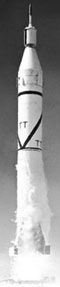
A modified Redstone missile specifically designed to carry lightweight payloads into low Earth orbit (LEO). Otherwise identical to the three-stage Jupiter C, it had a fourth stage that remained attached to the satellite in orbit. To reflect its non-military role, its name was officially changed from Jupiter to Juno at the request of JPL (Jet Propulsion Laboratory) chief William Pickering on 18 November 1957. It later became Juno I to distinguish it from the Juno II. A Juno I successfully launched Explorer 1, the first American satellite on 31 January 1958, and two more in the same year placed Explorer 3 and Explorer 4 into orbit.
 |
| Juno I
|
Juno II
A marriage of a Jupiter first stage and Juno I upper stages capable of delivering a 45-kg payload into LEO. The Juno name was also applied to the next generation of space launch vehicles designed by the Army Ballistic Missile Agency (ABMA), including a proposed Juno V super-booster. Eventually, the Juno program was transferred to NASA and renamed Saturn. Thus, the pioneering work of the ABMA, culminating in the successful use of Juno I and Juno II, led directly to the development of the rockets that would carry astronauts to the Moon.
 |
| Juno II
|

