
joint stability
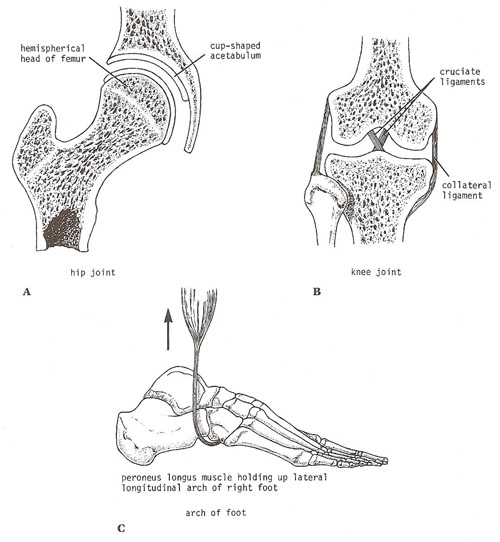
The three main factors responsible for stabilizing a joint: (A) shape of articular surfaces, (B) ligaments, and (C) muscle tone.
The stability of a joint depends on three main factors:
We'll now consider each of these factors in turn.
Articular surfaces
The ball-and-socket arrangement of the hip joint and the mortise arrangement of the ankle joint are good examples of how bone shape plays an important role in joint stability. There are other examples of joints, however, in which the shape of the bones contributes little or nothing to the stability; for example, the acromioclavicular joint, the calcaneocuboid joint, and the knee joint.
Ligaments
Fibrous ligaments will prevent excessive movement in a joint, but if the stress is continued excessively long, then fibrous ligaments stretch. For example, the ligaments of the joints between the bones forming the arches of the feet will not by themselves support the weight of the body. Should the tone of the muscles that normally support the arches became impaired by fatigue, then the ligaments will stretch and the arches will collapse, producing flat feet.
Elastic ligaments, on the other hand, return to their original length after stretching. The elastic ligaments of the auditory ossicles play an active part in supporting the joints and assisting in the return of the bones to their original position after movement.
Muscle tone
In most joints, muscle tone is the major factor controlling stability. For example, the muscle tone of the short muscles around the shoulder joint keeps the hemispherical head of the humerus in the shallow glenoid cavity. Without the action of these muscles, very little force would be required to dislocate this joint. The knee joint is very unstable without the tonic activity of the quadriceps femoris muscle. The joints between the small bones forming the arches of the feet are largely supported by the tone of the muscles of the leg, whose tendons are inserted into the bones of the feet.

