
216 Kleopatra
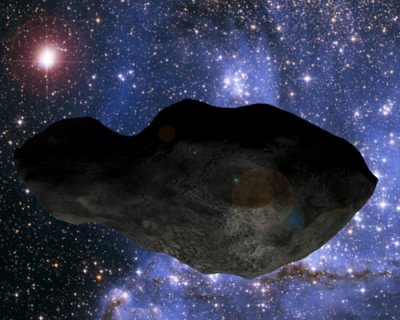
Artist rendition of Kleopatra. Credit: NASA.
216 Kleopatra is an M-class (metallic) main belt asteroid, discovered in 1880 by Johann Palisa, that was the first ever to have its shape imaged by ground-based radar. It resembles a dog bone the size of New Jersey.
Kleopatra's metallic composition indicates it came from the core of a large differentiated parent body that was smashed apart. But the origin of its double lobe nature is uncertain. It may have come about through the collision of two objects that had previously been thoroughly fractured and ground into piles of loosely consolidated rubble (see rubble-pile asteroid). Or, Kleopatra may once have been two separate lobes in orbit around each other with empty space between them, with subsequent impacts filling in the area between the lobes with debris.
| diameter | 217 × 94 km |
| spectral class | M |
| rotational period | 5.385 hours |
| semimajor axis | 2.793 AU |
| eccentricity | 0.254 |
| inclination | 13.1° |
| period | 4.67 years |

