
rubble-pile asteroid
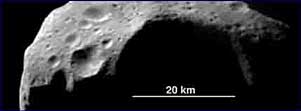
Large crater on Mathilde.
A rubble-pile asteroid is an asteroid that consists of a weak aggregate of large (boulder size) and/or small (gravel or sand-grain size) components held together by gravity rather than material strength. The asteroids 45 Eugenia and 253 Mathilde are both thought to have this kind of structure, as has Jupiter's moon Amalthea. In fact, astronomers suspect that many asteroids are agglomerations of fragments and, therefore, surprisingly fragile structures. If they are, this has far-reaching consequences for our understanding of how the planets formed and also the methods that might be used in the future to deflect asteroids that are on possible collision courses with Earth.
Evidence for rubble-pile structure
The idea that some asteroids may not be solid rock dates back to the late 1970s, when Clark R. Chapman, now at the Southwest Research Institute, and Donald R. Davis of the Planetary Science Institute in Tucson showed that the energy needed to break up an asteroid is a lot less than that needed to completely disperse all its fragments. As a result, if an asteroid were to be smashed into pieces by a collision with another asteroid, it would be more likely to reassemble itself into a loose collection of fragments – a so-called rubble pile – than to dissipate.
More recently, astronomers have found compelling (if not yet conclusive) evidence of rubble-pile structure. In some cases, they have seen giant craters gouged into asteroids. Images of the asteroid Mathilde, for instance, reveal at least five craters with a diameter of about 20 kilometers – fully half Mathilde's length. Simulations by Erik Asphaug of the University of California, Santa Cruz and Willy Benz of the University of Bern in Switzerland have shown that the fierce impacts needed to excavate such giant pits would have shattered a solid rocky body; the only way Mathilde could have survived is if it had already been a rubble pile. Mathilde's low density, measured in 1997 by the NEAR-Shoemaker craft, supports the notion that the asteroid is a porous collection of gravitationally-bound chunks.
Some of the strongest evidence in support of the rubble-pile model has come from studies of the rotation of asteroids. The largest asteroids tend to spin slowly. In fact, no one has ever observed an asteroid larger than 150 meters whose rotation period is less than 2 hours. This is just what the rubble-pile model predicts. If a 150-meter-wide rubble-pile asteroid were to spin any faster, the centrifugal force would overcome gravity and cause the fragments to fly apart. The only asteroids that spin faster are those less than 100 meters in diameter; thus, it seems that these small objects are solid chunks held together by the cohesive strength of their rock.
Astronomers still don't know what proportion of larger asteroids are rubble-pile and what are solid rock. It's very difficult to determine the internal constitution of a body in space, which is why close up studies by unmanned spacecraft are so vital. Investigation of the large asteroid 433 Eros by NEAR Shoemaker suggest that this particular object is monolithic, although it does have major fractures. More evidence on the make-up of asteroids is currently being provided by the Japanese probe Hayabusa which is studying the asteroid Itokawa.
Planet formation and asteroid families
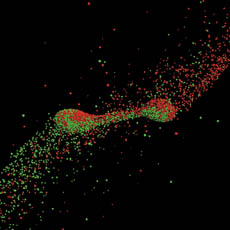 |
| Simulation of a collision between two rubble-pile
asteroids, depicted in red and green. Each asteroid has a diameter
of 2 km and is made of some 5,000 particles, each 100 meters across.
The collision took place at 2.6 meters per second – a typical speed
with which rocky objects may have collided during early planet formation.
Credit: Richardson and Leinhardt
|
If the rubble-pile model is an accurate depiction of most asteroids, theories of planet formation may need to be overhauled. According to the standard model, the terrestrial planets – Mercury, Venus, Earth, and Mars – arose when millimeter-size dust particles that surrounded the young Sun coalesced into house-size boulders, then asteroid-size objects, and finally planets. The asteroids observed today would be leftovers from that process. If asteroids in the early Solar System consisted of loosely bound collections of smaller rocks, the rate at which they would collide and stick may be different than current estimates. However, theorists aren't sure whether rubble-pile asteroids would be more or less efficient in building a planet.
The rubble-pile model may also have a bearing on the tally of asteroid families, each of which arose as chips off a different parent rock in the asteroid belt. The number of well-documented families observed today is about 20. Scientists used to think that more existed when the solar system was only a few hundred million yr old but that many were destroyed in subsequent collisions. If asteroids are rubble piles not easily shattered during collisions, however, then the number of families seen today may not be much different than what existed early on. We are probably seeing all the asteroid families that have ever been in the asteroid belt.
Deflecting a rubble-pile asteroid
Earth has been hit many times in the past by asteroids and will be struck again in the future – unless we take steps to deflect any object that is found to be on a collision course with us. The methods that have been proposed for dealing with an asteroid on an impact trajectory range from blowing it up with nuclear weapons to gently nudging it out of the way with a spacecraft. Surprisingly, if the rocky body hurtling toward us were of the rubble-pile type, it would be harder to deal with. Hitting it very hard with a fast-moving object (say, from a mass driver or trying to blow it up with a large nuclear weapon would be futile: the energy of the projectile or blast would be absorbed in the same way that the crumple zones of a car soak up the energy of a sudden collision. Instead, more subtle approaches have been suggested. One of these involves melting part of the asteroid's surface, perhaps using space mirrors, to produce jets of gas that would gradually ease the object into a new orbit. Another solution might be to use a robotic craft to paint one side of the surface of the asteroid with a substance that would change the rock's reflectivity or thermal conductivity. A large enough change would, over time, modify the asteroid's interaction with sunlight and alter its path. The efficacy of such plans would depend to a large extent on how much warning we had of the asteroid's threat. The gentle-nudge approach works only if applied over decades or even centuries.

