
Jupiter

Jupiter taken by the Cassini spacecraft from 16 million km on 29 December 2000.
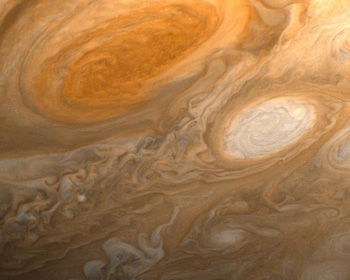
Jupiter taken by Voyager 1 on 1 March 1979, from a distance of 4.3 million kilometers (2.7 million miles). The photo shows Jupiter's Great Red Spot (top) and one of the white ovals that can be seen in Jupiter's atmosphere from Earth.

Jupiter and Earth compared.
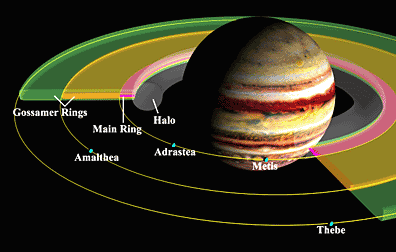
Jupiter's rings.

Artwork by Paul Calle of hypothetical life in Jupiter's atmosphere.
Jupiter is the largest planet in the Solar System and the fifth in order from the Sun. It
is a gas giant, with 11 times the diameter
of Earth, and two and half times the mass of all the other planets and satellites
combined. It has an extensive family of
satellites and a faint ring system.
In July 1994, Comet Shoemaker-Levy 9 collided with Jupiter with spectacular results.
| distance from Sun | 778.3 million km (483.7 million mi, 5.20 AU) |
| equatorial diameter | 142,984 km (88,864 mi) |
| equatorial diameter (Earth=1) | 11.209 |
| mass (Earth=1) | 317.9 |
| mean density | 1.3 g/cm3 |
| axial period | 9.8 hours |
| axial inclination | 3.1° |
| orbital period | 11.86 years |
| orbital inclination | 1.3° |
| orbital eccentricity | 0.048 |
| gravity at cloud-tops (Earth=1) | 2.64 |
| escape velocity | 60.2 km/s (216,720 km/h, 134,692 mph) |
| atmospheric composition | ~90% hydrogen, ~10% helium, traces of methane, etc |
| mean temperature (cloud tops) | -150°C (-238°F) |
| albedo | 0.43 |
| number of moons | 80 |
Atmosphere
Jupiter's immense atmosphere consists of about 75% hydrogen and 25% helium by mass (90% hydrogen and 10% helium by number of atoms), with trace amounts of methane, ammonia, and other light substances.
The upper atmosphere is striated into wide parallel bands at different latitudes because of a combination of the planet's rapid rotation and extensive convection caused by internal heat rising to the surface. Winds of more than 600 km/h blow in opposite directions in adjacent bands, while slight chemical and temperature differences between the bands are responsible for their different shades of yellow, brown, orange, and red. The light-colored bands are referred to as zones and the dark ones as belts. The zones are at a slightly higher altitude and about 15 K cooler than the belts. Complex vortices in the boundary regions between the bands were first seen by Voyager. The Galileo spacecraft's small descent probe also found turbulence in the Jovian atmosphere, indicating that Jupiter's winds are driven largely by the planet's internal heat rather than by solar radiation as on Earth.
The colors of the surface gases are believed to be due in part to the release of phosphorous and the formation of acetylene. The colors correlate with the cloud's altitude: blue lowest, followed by browns and whites, with reds highest. Sometimes we see the lower layers through gaps in the upper ones. An enormous elliptical region in Jupiter's South Equatorial Belt, known as the Great Red Spot, is thought to be a centuries'-old cyclone. Other similar but smaller and less long-lived spots have been known for decades. Intense lightning and powerful aurorae are other features of the Jovian atmosphere.
Great Red Spot
The Great Red Spot is a vast, swirling, oval feature in the equatorial region of Jupiter's atmosphere. Measuring about 14,000 kilometers from north to south and about 25,000 to 40,000 kilometers from east to west (big enough to hold a couple of Earths), it has a color that changes from pale pink or orange to brick red and back again over a timescale of years. This color may be due to the condensation of phosphorus at the cloud tops, to contamination by organic molecules such as nitriles produced by electrical storms, or to material dredged from deeper within Jupiter's atmosphere and then altered by the Sun's radiation.
The Spot is thought to be a hurricane-like disturbance caused and maintained by the Coriolis effect. Infrared observations and the direction of its rotation indicate that the Spot is a high-pressure zone whose cloud tops are significantly higher and colder than the surrounding regions. It has been studied for more than a century and may have been first seen over 300 years ago, its discovery usually attributed to Giovanni Cassini or Robert Hooke in the 16th century.
In early 2006, Jupiter acquired a second prominent red eye which has been nicknamed the Little Red Spot, although its official designation is Oval BA. It became a heavily-observed target in 1998 and 2000 when three white storms that had been observed for at least 60 years collided, creating one large white oval. This oval slowly turned to a salmon hue in December 2005, then over the next few weeks became the same color as the Great Red Spot. It is about half the size of its famous partner.
Near-infrared measurements indicate that the Little Red Spot may reach high above the main clouds, similar to the Great Red Spot. The images here add evidence to the idea that Jupiter is in the middle of significant climate change. Temperatures at some latitudes could be changing by over 5°C, scientists suggest. Another link to climate is that Red Spot Jr is forming at a latitude of 34° south. Theory has it that this is the where the transfer of heat from the equator to the pole comes to a halt.
The best view yet of the Little Red Spot was provided by the New Horizons spacecraft on 27 February 2007, as it swung past Jupiter on its way to Pluto. From a distance of 3 million kilometers, the probe's Long Range Reconnaissance Imager (LORRI) was able to snap a picture of the Spot at a resolution of 15 kilometers (9 miles) per pixel, which is 10 times better than the resolution provided by the Hubble Space Telescope.
Rotation
Jupiter spins around on its axis once every 9.8 hours (Jupiter's "day"). This is so fast, given Jupiter's size and the fact that it mostly a fluid, that Jupiter is noticeably squashed at its poles.
Measuring longitude values on Jupiter is complicated by the fact that the planet spins more rapidly near the equator than it does at the poles. Three systems are used. Jupiter System I is used for features within about 10° of the equator, where a full rotation takes about 9 hours 50.5 minutes. Jupiter System II is used for features north and south of this zone (such as the Great Red Spot), where a rotation takes about 9 hours 55.7 minutes. Finally, Jupiter System III, which is based on the rotation of Jupiter's interior, is used for radio observations and isn't particularly useful for visual observers. This rotation time of 9 hours 55.5 minutes probably reflects the rate at which the solid core of Jupiter rotates, far below the cloud layers.
Interior
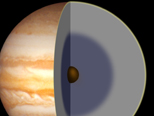 |
Jupiter radiates about 2½ times more heat than it receives from the Sun, indicating a substantial source of internal heat, almost certainly gravitational contraction, to account for the surface temperature. At its center, Jupiter is thought to have solid metal-rock core, similar in composition to Earth, with a diameter of about 24,000 kilometers and a mass of 10 to 15 Earth-masses. Surrounding this, out to a diameter of about 100,000 kilometers, is a metallic mixture of hydrogen and helium. On Earth we know these two as gases; in Jupiter's interior the pressure is so high that the hydrogen takes up a state in which it behaves like a metal. Outside this metallic hydrogen zone is a shell of liquid molecules, mainly hydrogen and helium, with the cloudy atmosphere, richer in ammonia and methane, about 1,000 kilometers deep, above. Temperatures range from -130°C at the top of the clouds, to 30°C about 70 kilometers below, to perhaps 20,000 K at the planet's center.
Magnetic field
Jupiter has a powerful magnetic field of about 4 gauss (the magnetic axis inclined 15° to the rotational axis and about 0.1 Jupiter radius from the center of the planet) and an immense magnetosphere that extends several million km in a Sunward direction and more than 650 million kilometers away from the Sun – past the orbit of Saturn! In Dec 1995, the Galileo atmospheric probe discovered a new intense radiation belt between Jupiter's ring and the uppermost atmospheric layers that is about 10 times as strong as Earth's Van Allen belts and contains high energy helium ions of unknown origin.
Moons
Jupiter has 92 known satellites. With one exception – Themisto – these moons fall into four major groups. The inner group of Metis, Adrastea, Amalthea, and Thebe are small- to medium-sized, orbit in nearly-circular paths at less than 200,000 kilometers, and were discovered as a result of images sent back by the Voyager probes. The Galilean moons, Io, Europa, Ganymede, and Callisto, have orbital radii of 400,000–2,000,000 kilometers and are among the largest satellites in the Solar System. The third group includes Leda, Himalia, Lysithea, and Elara, which were discovered in the 20th century but pre-Voyager, and S/2000 J11; all have diameters of less than 200 kilometers and orbits of 11 to 13 million kilometers with inclinations of 26–29°. The fourth group, composed of several subgroups, includes four moons, Ananke, Carme, Pasiphae, and Sinope, whose 20th-century discovery predates Voyager, plus many others found recently; all, with the exception of Pasiphae, have diameters of less than 50 kilometers and high-inclination, retrograde orbits with radii of 19 to 30 million kilometers. It is thought that the three groups of smaller moons may each have a common origin, perhaps as a larger moon or captured body that broke up into the existing moons of each group.
All Jupiter's moons are tidally locked with the planet so that their rotational periods and orbital periods are the same. All the known moons beyond Carpo move in retrograde orbits. For further details on some of the moons that have been given proper names, see individual entries (click on the names in the table below). They are listed in order of increasing distance from the planet.
The values of semimajor axis and orbital period, eccentricity, and inclination, for all the moons of Jupiter beyond and including Themisto were obtained from the Natural Satellites Empheris Service of the IAU Minor Planet Center.
| moon | semimajor axis (km) |
orbital period (days) |
orbital eccentricity |
orbital incl (°) |
diameter (km) |
| Metis | 127,690 | 0.2948 | 0.00002 | 0.06 | 60×40×34 |
| Adrastea | 128,690 | 0.2983 | 0.0015 | 0.03 | 20×16×14 |
| Amalthea | 181,370 | 0.4982 | 0.0032 | 0.374 | 250×146×128 |
| Thebe | 221,890 | 0.6745 | 0.0175 | 1.076 | 116×98×84 |
| Io | 421,700 | 1.769 | 0.0041 | 0.050 | 3,643 |
| Europa | 671,030 | 3.551 | 0.0094 | 0.471 | 3,122 |
| Ganymede | 1,070,410 | 7.155 | 0.0011 | 0.204 | 5,262 |
| Callisto | 1,882,710 | 16.69 | 0.0074 | 0.205 | 4,821 |
| Themisto | 7,393,220 | 129.87 | 0.2116 | 45.762 | 8 |
| Leda | 11,098,500 | 238.86 | 0.1801 | 27.376 | 10 |
| Himalia | 11,377,500 | 247.93 | 0.1361 | 29.872 | 170 |
| Lysithea | 11,756,000 | 260.40 | 0.1277 | 26.600 | 36 |
| Elara | 11,763,800 | 260.66 | 0.1948 | 30.646 | 86 |
| S/2000 J11 | 12,570,600 | 287.93 | 0.2058 | 27.584 | 4 |
| Carpo | 17,144,900 | 458.62 | 0.2736 | 56.001 | 3 |
| S/2003 J12 | 17,739,500 | -482.69 (r) | 0.4449 | 142.686 | 1 |
| Euporie | 19,088,400 | -538.78 (r) | 0.0960 | 144.694 | 2 |
| S/2003 J3 | 19,621,800 | -561.52 (r) | 0.2507 | 146.363 | 2 |
| S/2003 J18 | 19,812,600 | -569.73 (r) | 0.1570 | 147.401 | 2 |
| Ananke | 20,439,100 | -596.96 (r) | 0.3121 | 150.187 | 28 |
| Thelxinoe | 20,453,800 | -597.61 (r) | 0.2685 | 151.293 | 2 |
| Euanthe | 20,464,900 | -598.09 (r) | 0.2001 | 143.409 | 3 |
| Helike | 20,540,300 | -601.40 (r) | 0.1375 | 154.587 | 4 |
| Orthosie | 20,568,000 | -602.62 (r) | 0.2433 | 142.367 | 2 |
| Iocaste | 20,722,600 | -609.43 (r) | 0.2874 | 147.249 | 5 |
| S/2003 J16 | 20,743,800 | -610.36 (r) | 0.3185 | 150.769 | 2 |
| Praxidike | 20,823,900 | -613.90 (r) | 0.1840 | 144.206 | 7 |
| Harpalyke | 21,063,800 | -624.54 (r) | 0.2441 | 147.224 | 4 |
| Mneme | 21,129,800 | -627.48 (r) | 0.3169 | 149.733 | 2 |
| Hermippe | 21,182,100 | -629.81 (r) | 0.2290 | 151.242 | 4 |
| Thyone | 21,405,600 | -639.80 (r) | 0.2526 | 147.276 | 4 |
| S/2003 J17 | 22,134,300 | -672.75 (r) | 0.2379 | 162.491 | 2 |
| Aitne | 22,285,200 | -679.64 (r) | 0.3927 | 165.563 | 3 |
| Kale | 22,409,200 | -685.32 (r) | 0.2011 | 165.379 | 2 |
| Taygete | 22,438,600 | -686.67 (r) | 0.3678 | 164.890 | 5 |
| S/2003 J19 | 22,709,100 | -699.12 (r) | 0.1961 | 164.728 | 2 |
| Chaldene | 22,713,400 | -699.33 (r) | 0.2916 | 167.071 | 4 |
| S/2003 J15 | 22,721,000 | -699.68 (r) | 0.0932 | 141.813 | 2 |
| S/2003 J10 | 22,730,800 | -700.13 (r) | 0.3439 | 163.813 | 2 |
| S/2003 J23 | 22,739,700 | -700.54 (r) | 0.3931 | 148.850 | 2 |
| Pasiphaë | 22,928,200 | -709.27 (r) | 0.2914 | 144.292 | 60 |
| Erinome | 22,986,300 | -711.96 (r) | 0.2552 | 163.738 | 3 |
| Aoede | 23,044,200 | -714.66 (r) | 0.6012 | 160.482 | 4 |
| Kallichore | 23,111,800 | -717.81 (r) | 0.2042 | 164.605 | 2 |
| Kalyke | 23,180,800 | -721.02 (r) | 0.2140 | 165.505 | 5 |
| Callirrhoe | 23,215,000 | -722.62 (r) | 0.2582 | 139.850 | 9 |
| Eurydome | 23,230,900 | -723.36 (r) | 0.3770 | 149.324 | 3 |
| Pasithee | 23,307,300 | -726.93 (r) | 0.3289 | 165.759 | 2 |
| Carme | 22,371,300 | -683.58 (r) | 0.2593 | 165.943 | 46 |
| Cyllene | 23,396,300 | -731.10 (r) | 0.4116 | 140.149 | 2 |
| Eukelade | 23,483,700 | -735.20 (r) | 0.2829 | 163.996 | 4 |
| S/2003 J4 | 23,570,800 | -739.29 (r) | 0.3003 | 147.176 | 2 |
| Hegemone | 23,702,500 | -745.50 (r) | 0.4077 | 152.506 | 3 |
| Arche | 23,717,100 | -746.19 (r) | 0.1492 | 164.587 | 3 |
| Isonoe | 23,800,600 | -750.13 (r) | 0.1776 | 165.128 | 4 |
| S/2003 J9 | 23,857,800 | -752.84 (r) | 0.2762 | 164.980 | 1 |
| S/2003 J5 | 23,973,900 | -758.34 (r) | 0.3071 | 165.550 | 4 |
| Sinope | 24,130,600 | -765.79 (r) | 0.1970 | 155.005 | 38 |
| Sponde | 24,252,600 | -771.60 (r) | 0.4432 | 154.373 | 2 |
| Autonoe | 24,264,400 | -772.17 (r) | 0.3690 | 151.058 | 4 |
| Kore | 24,345,100 | -776.02 (r) | 0.1951 | 137.372 | 2 |
| Megaclite | 24,687,200 | -792.44 (r) | 0.3078 | 150.398 | 5 |
| S/2003 J2 | 30,290,800 | -1077.02 (r) | 0.1882 | 153.521 | 2 |
r = retrograde
Rings
Jupiter has a faint ring system with four main components: the halo ring, the main ring, and the two gossamer rings. It was first detected by Voyager 1.
The main ring encompasses the orbits of the two innermost moons Adrastea and Metis, and at its inner edge merges into the halo, a broad, faint torus of material extending halfway from the main ring to Jupiter's cloud-tops. Just outside the main ring are the broad and extremely faint gossamer rings, one bounded by the orbit of Amalthea, the other by the orbit of Thebe.
In 1996–1997 the Galileo spacecraft recorded events showing how Jupiter's rings are still being formed. Comet and meteor debris, accelerated by Jupiter's powerful gravitational field, smash into the inner four moons flinging dark-red surface material into space. Galileo took pictures of the red dust coming off Amalthea and Thebe, the two moons orbiting in the gossamer ring. The dust travels so fast that it escapes the minute gravitational fields of the tiny moons and goes into orbit. It then enters the gossamer rings and adds to the collection that has been accumulating there over billions of years. A similar process involving Adrastea and Metis are thought to supply the particles for the main and halo rings.
| name | inner radius (km) | outer radius (km) | width (km) |
| halo ring | 100,000 | 122,800 | 22,800 |
| main ring | 122,800 | 129,100 | 6,300 |
| gossamer ring | 129,100 | 250,000+ | 121,000+ |
Speculation about life
There has been much speculation that any life on Jupiter, or on other gas giants, might be ammonia-based life. The possibility of "abundant biota" in the upper regions of Jupiter's atmosphere was considered in a 1976 paper by Carl Sagan and Edwin E. Salpeter1, three years after the fly-by of the first Jupiter probe, Pioneer 10. Sagan and Salpeter compared the ecology of the Jovian atmosphere with that of terrestrial seas which have simple photosynthetic plankton at the top level, fish at lower levels feeding on these creatures, and marine predators which hunt the fish. The three hypothetical Jovian equivalents of these organisms, Sagan and Salpeter termed "sinkers", "floaters", and "hunters". They envisaged creatures like giant gas-bags (see bubble life) that move by pumping out helium and calculated that the "hunter" variety might grow to be many kilometers across (and therefore visible from space).
Jovian aerial life-forms like those described by Sagan and Salpeter are portrayed in Arthur C. Clarke's short story "A Meeting with Medusa" (in The Wind From the Sun). Ben Bova refers in his novel Jupiter to:
"[H]uge balloonlike creatures called Clarke's Medusas that drifted in the hurricane-like winds surging across the planet. Birds that have never seen land, living out their entire lives aloft. Gossamer spider-kites that trapped microscopic spores. Particles of long-chain carbon molecules that form in the clouds and sift downward, toward the global ocean below."
Bova speculates further that, in the high-pressure, liquid hydrogen ocean that lies below Jupiter's thick atmosphere, are colossal, city-sized creatures with intelligence. He follows the exploits of one of these sentient giants – Leviathan:
"Predators swarmed through Leviathan's ocean: swift voracious Darters that struck at Leviathan's kind and devoured their outer members."
In recent years, astrobiological interest in the Jovian system has shifted from Jupiter itself to its larger moons, especially Europa, Ganymede, and Callisto.
Reference
1. Sagan, C., and Salpeter, E. E. "Particles, Environments and Possible Ecologies in the Jovian Atmosphere," Astrophysical Journal Supplement, 32, 737 (1976).
Other facts
Other measurements by the atmospheric probe confirmed that Jupiter and the Sun have almost the same elemental composition and formed therefore from the same primordial mixture in the solar nebula. However, not all of the probe's measurements tied in with theoretical predictions, the biggest surprise being the lack of water in the upper atmosphere. Several ideas have been put forward to explain this finding. Perhaps water concentrations vary with latitude, a suggestion that ties in with the observation that most of Jupiter's lightning (an activity associated with water clouds) occurs at middle latitude whereas the probe descended near the planets' equator. Another possibility is that, during Jupiter's formation, water tended to be confined to the planet's core by the massive overlying blanket of hydrogen and helium.
Jupiter orbits the Sun five times further out than does the Earth, so that each unit area of its surface receives only about one twenty-fifth, or 4%, of the solar energy falling on a similar-sized patch of our own world. Although Jupiter has virtually the same elemental composition as the Sun, it would have needed at least 10 times more mass in order to have become a brown dwarf, and about 80 times more mass in order to have initiated nuclear reactions and shone as a star.

