
brown dwarf
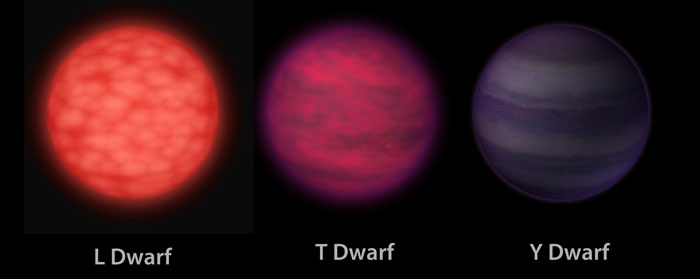
Artist's conception of what brown dwarfs of different types might look like to a hypothetical interstellar traveler who has flown a spaceship to each one. The objects are progressively cooler in atmospheric temperatures as you move from left to right. Y dwarfs are the newest and coldest class of brown dwarfs to be discovered, by NASA's Wide-field Infrared Survey Explorer. The L dwarf is seen as a dim red orb to the eye. The T dwarf is even fainter and appears with a darker reddish, or magenta, hue. The Y dwarf is dimmer still. Because astronomers have not yet detected Y dwarfs at the visible wavelengths we see with our eyes, the choice of a purple hue is done mainly for artistic reasons. The Y dwarf is also illustrated as reflecting a faint amount of visible starlight from interstellar space. In this rendering, the traveler's spaceship is the same distance from each object. This illustrates an unusual property of brown dwarfs – that they all have the same dimensions, roughly the size of the planet Jupiter, regardless of their mass. This mass disparity can be as large as 15 times or more when comparing an L to a Y dwarf, despite the fact that both objects have the same radius. Caption and image credit: NASA/JPL-Caltech.

Credit: Gemini Observatory/Artwork by Jon Lomberg.
A brown dwarf is a substellar object – one that is intermediate in mass between a star and a planet. Brown dwarfs (which are not really brown but a very dull red) are sometimes described as "failed stars" because they are not massive enough to have initiated hydrogen fusion (see hydrogen burning) in their cores. They are also commonly referred to as "missing links" between gas giants, such as Jupiter, and red dwarfs, which are the smallest, lowest-mass true stars. The name was coined by Jill Tarter in the 1970s. The first brown dwarf to be confirmed, in 1995, on the basis of a combination of mass determination, spectroscopic studies, and direct imaging was Gliese 229B. Hundreds are now known.
When is an object a brown dwarf?
A brown dwarf may be defined in one of two main ways: by its mass or its origin. The former is normally used for practical purposes since it is easier to measure an object's mass than to establish how it was made. The upper mass for a brown dwarf is that which is just insufficient for normal hydrogen fusion to be triggered in the core. Based on theoretical considerations, this is believed to be between 0.075 and 0.080 solar mass, or 75 to 80 times the mass of Jupiter. The lower mass limit is somewhat arbitrary as there is no obvious point of transition between a high-mass planet and a low-mass brown dwarf, but it is generally taken to be about 0.013 solar mass, or 13 times the mass of Jupiter.
Some astronomers argue that a more significant distinction between planets and brown dwarfs is their mode of formation. By this criterion, brown dwarfs are held to form in the same way as stars, as condensations in an interstellar gas cloud (see stars, evolution). Planets, by contrast, accrete from material in a circumstellar disk (see planets, formation).
Detecting brown dwarfs
Brown dwarfs are too cool to give off much visible light but they do emit substantial amounts of infrared radiation as a result of slow gravitational contraction and small-scale deuterium fusion. They are thus amenable to detection by ground-based and spaceborne infrared telescopes. As in the case of extrasolar planets, brown dwarfs can also be found if they happen to be orbiting a star; the presence of the brown dwarf is indicated by wobbles that it causes in the motion of its companion star across the sky. The radial velocity method has been successful in identifying a large number of brown dwarfs in orbit around stars. Telescopes equipped with coronagraphs may be able to image the candidate brown dwarf at visible wavelengths, as was the case with Gliese 229B.
Distinguishing brown dwarfs from star and planets
High-mass brown dwarfs can generally be distinguished from low-mass stars by the presence of lithium in their spectra. Lithium is rapidly consumed by nuclear reactions in hydrogen-fusing stars. However, there are some exceptions. Lithium may still be present in very young stars, and be absent in brown dwarfs with masses greater than about 65 solar masses and ages greater than about 500 million years. Another tell-tale substance found in older brown dwarfs is methane. Finally, stars of every very low mass attain at least 0.01% of the luminosity of the Sun, whereas brown dwarfs are much dimmer.
One way to distinguish low-mass brown dwarfs from gas giant planets is by their density, which is higher. Remarkably, all brown dwarfs, whatever their mass, are about the same size – just a little larger than Jupiter. But because they are much more massive than Jupiter, their densities are considerably greater. Some brown dwarfs also differ from planets in that they emit X-rays. The more massive a brown dwarf, the higher its surface temperature, though a typical value is about 1000K.
Types of brown dwarf
At the high-mass, high-temperature end of the brown dwarf scale are the ultra-cool dwarfs, with dusty atmospheres and a spectral type of M7 or later. Late M-types, with surface temperatures as low as 2,200K, have water and strong oxide features in their spectra and may be red dwarfs or brown dwarfs, depending on their mass. For brown dwarfs smaller and cooler than type M, a new spectral category has been allocated – type L. With temperatures of about 1,500K to 2,200K, L dwarfs have spectra characterized by strong metal hydride bands and even prominent water bands. Cooler still are the so-called T-types, or methane dwarfs, with surface temperatures ranging from about 1,500K to 1,000K or even 800K, and spectra that show strong absorption by methane and water. Coolest of all, discovered in 2011 using data from the WISE mission, are Y-types, with temperature as cool as the human body.
Brown dwarfs do not glow, even dully for very long. As soon as they have used up their meager supply of deuterium, which takes about 10 million years, they fade from dim dark red to black. However, there are stars that start out as ordinary hydrogen-fusing red dwarfs and then get whittled away to brown dwarf size. The binary systems LL Andromedae and EF Eridani both contain white dwarf primaries that have looted material from their partners and reduced them to 40-Jupiter-mass objects, with surface temperatures of about 1,300 K and 1,650 K, respectively.
Where brown dwarfs are found
While some brown dwarfs, like Gliese 229B, are part of binary systems, others having been found floating around on their own, including a number in the Pleiades, the Sigma Orionis star cluster, and the Trapezium. PPl 15, in the Pleiades, is a binary system in which both components are brown dwarfs. S Ori 47, in the Sigma Orionis cluster, holds the record for the brown dwarf with the smallest known mass – a mere 0.015 solar mass. Some objects, such as the companion of HD 114762, lie close to the borderline between massive planets and low-mass brown dwarfs.
A surprisingly high proportion of brown dwarfs have been found as companions to low-mass (red dwarf or other brown dwarf) stars, and, within these systems, the separation between the two components is typically very small, averaging about 4 AU. This goes against the prediction by some theorists that most very low-mass stars and brown dwarfs are solo objects, wandering though space alone after being ejected out of their stellar nurseries during the star formation process. Very few brown dwarf companions of larger, Sun-like have been found inside 5 AU, a deficiency that has been dubbed the "brown dwarf desert;" however, there is no such desert associated with low-mass stars. The observations to date strongly support the idea that low-mass binaries form in a process similar to that of more massive binaries, and that the percentage of binary systems is similar for bodies spanning the range from one solar mass to as little as 0.05 solar mass.
Yet, there are also many lone brown dwarfs, such as KELU-1, discovered in 1997. At a distance of only 33 light-years from the Sun, it was one of the closest brown dwarfs known at that time. Such solitary dwarfs could be ejected stellar embryos – small infant stars that were still accreting material when they were kicked out of the nest by more massive siblings in multiple stellar systems. On the other hand, observations of some brown dwarfs in the Orion Nebula, which show an excess of near-infrared radiation, point to the presence of dusty disks around these objects. Not only does this suggest a normal stellar formation process but also the possibility that brown dwarfs might develop planetary systems. Whether life could ever emerge on such worlds whose sun is so cool and dim, is a question for the future.
