
gas giant
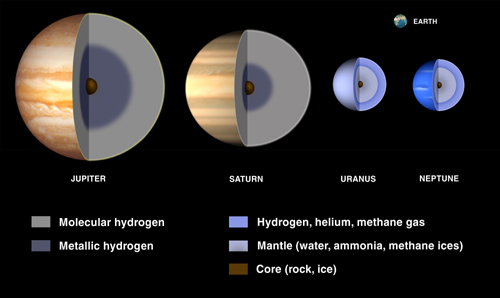
Gas giant interiors: Jupiter, Saturn, Uranus, and Neptune compared.
A gas giant is a large planet composed mainly of hydrogen and helium, together with some methane, ammonia, and other light substances, but with a substantial metal-rock core around which the lighter materials that form the bulk of the object have accreted.
The four gas giants of the Solar System are, in order of increasing distance from the Sun, Jupiter, Saturn, Uranus, and Neptune. Jupiter illustrates why the term "gas giant" (coined by the science fiction writer James Blish) is somewhat of a misnomer. Apart from having a sizeable solid core, Jupiter also has much of its hydrogen in either liquid or, at greater depths, solid, quasi-metallic form.
Most of the exoplanets discovered so far appear to be gas giants, though this is a selection effect stemming from the fact that current detection methods are heavily biased toward finding massive planets. The upper mass limit of a gas giants is thought to be around 13 times the mass of Jupiter. Above this, theory suggests that the pressure inside an object is sufficient to induce a modest level of deuterium fusion, which produces enough heat for the object to glow dully as a brown dwarf. Gas giants are also referred to as jovians or as Jupiter-type planets.
Formation of gas giants
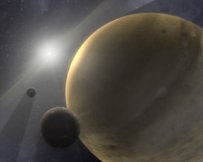 |
| Artist's concept of a hypothetical 10-million-yr-old
star system. A newly formed gas giant is in foreground. Image credit:
NASA/JPL-Caltech/T. Pyle, SSC
|
Astronomers announced in 2006 that observations from NASA's Spitzer Space Telescope show that gas giants either form very early on – within the first 10 million years – of a sun-like star's life, or not at all. Ilaria Pascucci of the University of Arizona Steward Observatory led a team of astronomers who carried out a comprehensive search, using Spitzer, for gas around 15 different sun-like stars, most with ages ranging from 3 million to 30 million years. In addition, some of the team members probed for cold gas in the outer regions of these star systems with the Arizona Radio Observatory's 10-meter Submillimeter Telescope (SMT) on Mount Graham. The outer zones of these star systems are analogous to the region around Saturn's orbit and beyond in our own solar system.
All of the stars in the study, including those as young as a few million years, have less than 10 percent of Jupiter's mass in gas swirling around them. This indicates that gas giant planets like Jupiter and Saturn have already formed in these young solar system analogs, or they never will.

