
planet

Figure 1. The Solar System is now considered to have 8 planets and several known dwarf planets, including Pluto, Ceres, and Eris.
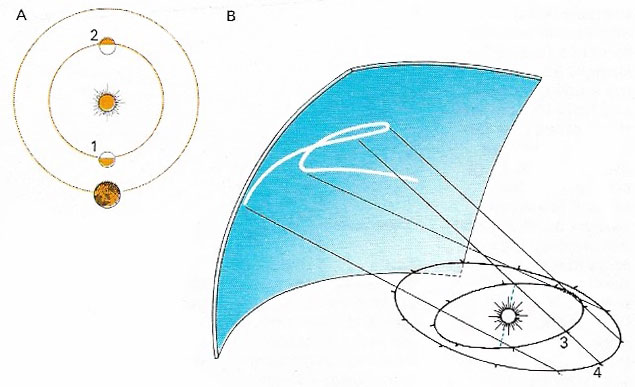
Figure 2. The two planets whose orbits lie within that of the Earth – Mercury and Venus – show lunar-type phases and remain in the same area of the sky as the Sun (A). An inner planet is at inferior conjunction (1); its dark side is turned towards Earth so it appears "new". When on the far side of the Sun (2), it is full. The synodical period, or mean interval between successive inferior conjunctions, is 115.0 days for Mercury and 583.9 days for Venus. The orbits of the earth (4) and Venus are shown (B) and the white line indicates apparent motion of Venus in the sky. Mercury behaves in a similar way.
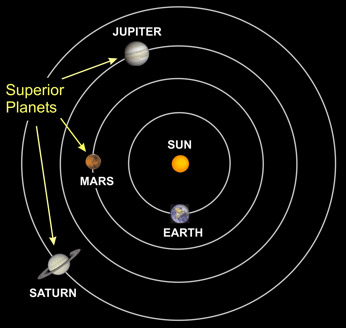
Figure 3. Orbits of superior planets.
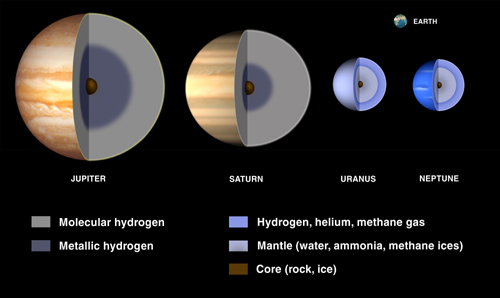
Figure 4. Gas giant and ice giant interiors compared: Jupiter, Saturn, Uranus, and Neptune.
A planet is a body that orbits a star, is massive enough to have pulled itself into a rounded shape by gravity but not massive enough to have started nuclear fusion reactions in its core, is not a satellite, and has cleared its neighborhood of smaller bodies, known collectively as planetesimals. According to this definition, adopted in 2006 by astronomers at a meeting of the International Astronomical Union, there are eight known planets in the Solar System: Mercury, Venus, Earth, Mars, Jupiter, Saturn, Uranus, and Neptune. Pluto has been relegated to the status of dwarf planet, as it has not cleared the neighborhood around its orbit (Figure 1).
By position relative to the Sun, there are four inner planets (Mercury, Venus, Earth, and Mars) and four outer planets (Jupiter, Saturn, Uranus, and Neptune), with the asteroid belt marking the boundary between the inner and outer Solar System. By position relative to Earth, Mercury and Venus are described as inferior planets (Figure 2), whereas all planets beyond Earth, including Mars, are said to be superior (Figure 3).
Exoplanets
See main entry
Thousands of planets have also been found orbiting stars other than the Sun. Some of these exoplanets are similar in size and/or in other respects to the planets in the Solar System. However, in space as a whole there is surprisingly wide diversity of planets, including very large planets in very small orbits around their central stars.
Types of planet
Double planet
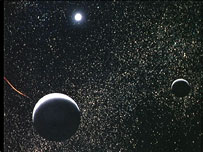 |
| Pluto and Charon.
|
A double planet is two objects of comparable size and of planetary mass orbiting one another. There is controversy over where to draw the line between a double planet and a system consisting of a planet and a moon. In most cases, satellites are of much small mass than their primary. However, there are two known examples of moon/planet mass ratios much greater than average: those of Earth and the Moon, and of Pluto and Charon.
A commonly accepted criterion of a double planet is when the center of gravity of the two objects is not located inside either body. By this rule, Pluto and Charon count as a double planet while the Earth-Moon system does not. The question of whether Pluto is a planet at all, or should instead be regarded as a large, wayward Kuiper Belt object is a separate matter.
Earth-class planet
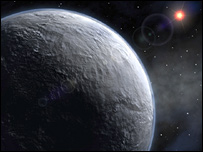 |
An Earth-class planet is a planet having a mass 0.5 to 10 times that of the Earth (Me) and a radius 0.8 to 2.2 times that of the Earth. Planets more massive than 10 Me have enough gravity to attract a large hydrogen-helium atmosphere and so become gas giants. Those less massive than 0.5 Me are likely to lose any potentially life-supporting atmosphere because of low gravity and lack of plate tectonics needed to recycle carbon dioxide back into the atmosphere.
Eccentric Jupiter
See main entry
Eccentric Jovians are exoplanets with a mass similar to or greater than that of Jupiter, which move around their host stars in highly elongated orbits. Examples include planetary companions of 70 Virginis and 16 Cygni B.
Gas giant
See main entry
A gas giant, or Jovian planet, is a large planet composed mainly of hydrogen and helium, together with some other light substances such as methane, ammonia, and water vapor, but with a substantial metal-rock core around which the lighter materials that form the bulk of the object accreted. There are two gas giants in the Solar System: Jupiter and Saturn. Jupiter illustrates why the term "gas giant" (coined by the science fiction writer James Blish) is somewhat of a misnomer. Apart from having a sizeable solid core, Jupiter also has much of its hydrogen in either liquid or, at greater depths, solid, quasi-metallic form (Figure 4). Many exoplanets are presumed to be gas giants because of their high mass.
Giant planet
A giant planet is a planet that is much larger and more massive than Earth. In practical terms, this probably means that all giant planets are gas giants, since it is hard to see how an exclusively rock-metal planet could acquire enough material in a protoplanetary nebula to take on such huge proportions.
Hot Jupiter
See main entry
Hot Jupiters, also called epistellar Jovians, are exoplanets with masses similar to or greater than that of Jupiter but in very small orbits around their central stars, typically with periods of less than 10 days. Many of the first exoplanets to be discovered were of this type because they are the easiest ones to detect by the radial velocity method. Their surface temperatures are believed to range from about 1,000 to 1,700°C (1,800 to 3,100°F). However, their large gravitational pulls mean that such high temperatures are no impediment to them retaining massive hydrogen atmospheres.
Ice giant
Uranus, and Neptune were once grouped with their larger neighbors, Jupiter and Saturn, in the gas giant category. Now, however, they are recognized as being different in composition, being primarily made of heavier volatile substances, which are known collectively as "ices". For this reason, they and any exoplanets like them as known as ice giants.
Pulsar planet
See main entry
A pulsar planet is a planet in orbit around a pulsar. Two such systems are known and were among the first exoplanets to be discovered.
Rogue planet
See main entry
Super-Earth
See main entry
A super-Earth is a planet with a mass greater than that of Earth but less than either of the Solar System's ice giants, Uranus and Neptune. The name does not imply anything about their potential to support life but refers only to their mass.
Terrestrial planet
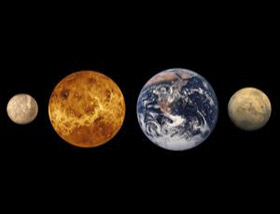 |
| When the four terrestrial planets of the solar system
– Mercury, Venus, Earth and Mars – are placed side by
side, it's clear their size distribution is close to symmetrical,
with the two largest lying between the two smallest. Image: NASA.
|
A terrestrial planet is a relatively small planet of high density with a solid, rocky surface. The terrestrial planets in the Solar System are Mercury, Venus, Earth, and Mars. Dozen of terrestrial planets have also been found in orbit around other stars. It is not yet known if these small exoplanets are similar in composition to Earth and its neighbors in being made primarily of silicate rock with an iron-nickel core. The existence of carbon planets, iron planets, and coreless terrestrial planets has been hypothesized.

