
New Horizons Pluto-Kuiper Belt mission

New Horizons trajectory.

The science payload includes seven instruments:
Ralph: Visible and infrared imager/spectrometer; provides color, composition and thermal maps
Alice: Ultraviolet imaging spectrometer; analyzes composition and structure of Pluto's atmosphere and looks for atmospheres around Charon and Kuiper Belt Objects<
REX: (Radio Science EXperiment) Measures atmospheric composition and temperature; passive radiometer
LORRI: (Long Range Reconnaissance Imager) telescopic camera; obtains encounter data at long distances, maps Pluto's farside and provides high resolution geologic data
SWAP: (Solar Wind Around Pluto) Solar wind and plasma spectrometer; measures atmospheric "escape rate" and observes Pluto's interaction with solar wind
PEPSSI: (Pluto Energetic Particle Spectrometer Science Investigation) Energetic particle spectrometer; measures the composition and density of plasma (ions) escaping from Pluto's atmosphere
SDC: (Student Dust Counter) Built and operated by students; measures the space dust peppering New Horizons during its voyage across the solar system
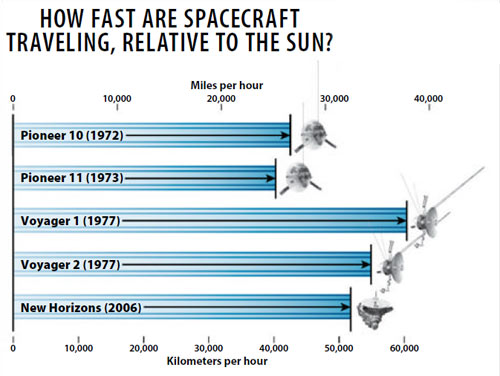
Speeds of Pioneers 10 and 11, Voyagers 1 and 2, and New Horizons relative to the Sun.
New Horizons is a NASA mission to explore Pluto, its largest moon Charon, and the Kuiper belt. Designed and built at the Johns Hopkins University Applied Physics Laboratory, Laurel, Maryland, New Horizons was launched from Cape Canaveral Air Force Station on 19 January 2006.
 |
Having launched before the critical date of 3 February allowed New Horizons
to take advantage of a gravity-assist (a slingshot effect) from Jupiter, in early
2007, to boost its speed to about 51,000 mph (23 kilometers per second) – a spacecraft
record. The Jupiter flyby trimmed the trip to Pluto by five years, enabling
arrival at Pluto-Charon in July 2015. It also provided an opportunity to
test the spacecraft's instruments and flyby capabilities on the Jupiter
system.
New Horizons conducted a five-month-long study of the Pluto system, as
it approached, flew pastpast (closest approach on 14 July 2015), and receded
from its target. It studied the global geology and geomorphology of Pluto
and Charon, mapped their surface compositions and temperatures, and examined
Pluto's atmospheric composition and structure.
The spacecraft also studied the family of small moons recently discovered in orbit around Pluto (for details see Pluto, moons). New Horizons then headed deeper into the Kuiper Belt to investigate one or more of the icy mini-worlds in this vast region, at least a billion miles beyond Neptune's orbit.
The spacecraft
The 1,050-pound, piano-sized probe was launched on 19 January 2006, by an Atlas V rocket, then given a final boost by a kick-stage solid propellant motor. It achieved the highest Earth escape velocity of any spacecraft 57,600 kilometers per hour (35,800 mph), reaching lunar orbit distance just nine hours after third stage separation and on track to surpass the distance of Jupiter 13 months later. (See fastest spacecraft).
The New Horizons science payload, developed under direction of Southwest Research Institute, includes imaging infrared and ultraviolet spectrometers, a multi-color camera, a long-range telescopic camera, two particle spectrometers, a space-dust detector and a radio science experiment. The dust counter was designed and built by students at the University of Colorado, Boulder.
The spacecraft slept in electronic hibernation for much of the cruise to Pluto. Operators were turned off all but the most critical electronic systems and monitor the spacecraft once a year to check out critical systems, calibrate instruments and perform course corrections, when necessary.
The spacecraft sends back a beacon signal each week to give operators an instant read on spacecraft health. The entire spacecraft, drawing electricity from a single radioisotope thermoelectric generator, operates on less power than a pair of 100 wattshousehold light bulbs.

