
moons of Pluto
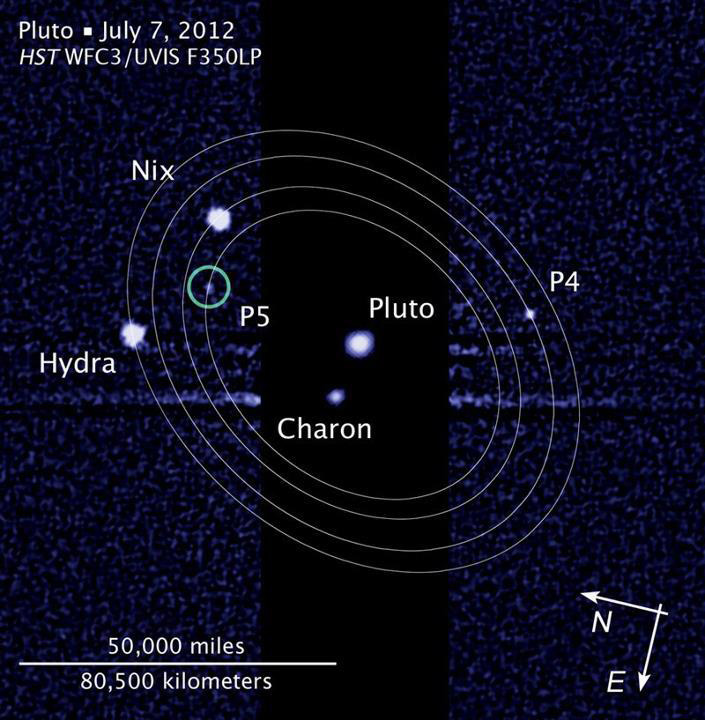
Pluto and its five known known moons. Image credit: NASA, ESA, and M. Showalter (SETI Institute).
Pluto has five known moons. The innermost of these and by far the largest is Charon, discovered in 1978. All four of the smaller moons were discovered from observations by the Hubble Space Telescope: the first two, Hydra (S/2005 P1) and Nix (S/2005 P2), in 2005, the third, Kerberos (S/2011 P1), in 2011, and the fourth Styx (S/2012 P1), in July 2012. All the moons move in retrograde, coplanar, and nearly-circular orbits around Pluto. Nix, S/2011 P3, and Hydra appear to be in 1:4:5:6 orbital resonances, respectively, with the Charon-Pluto orbital period.
The latest moon to be found, Styx, is 9 to 24 kilometers (6 to 15 miles) across and moves in a circular orbit, about 47,000 kilometers (29,500 miles) in radius, between the orbits of Charon and Nix. It was discovered during a telescopic survey of the Pluto system for potential hazards to the New Horizons probe which arrived at the dwarf planet in 2015.
| moon | semimajor axis (km) |
orbital period (days) |
orbital eccentricity |
orbital inclination (o) |
diameter (km) |
| Charon | 17,536 ± 3 | 6.387 | 0.0022 | 0.001 | 1,207 ± 3 |
| Styx | ~47,000 | - | ~0 | - | 9 – 24 |
| Nix | 48,708 | 24.85 | 0.0030 | 0.195 | 46 – 137 |
| Kerberos | ~59,000 | 32.1 | ~0 | ? | 13 – 34 |
| Hydra | 64,749 | 38.21 | 0.212 | 0.006 | 61 – 167 |

