
lichen
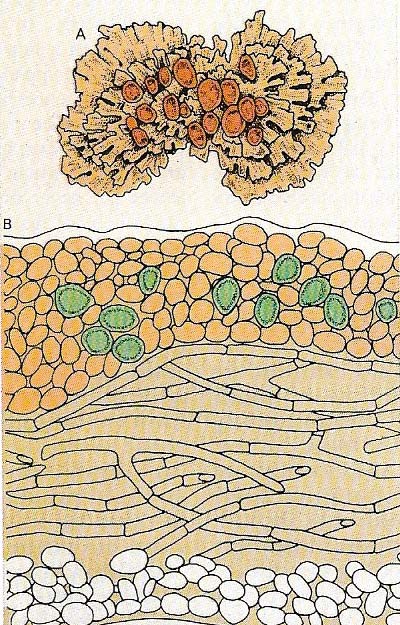
Figure 1. Lichens arise from the mutually beneficial partnership that can develop between and fungus and an alga and/or cyanobacterium. Xanthoria parietina (A) is commonly found along coasts on rocks and on the walls and roofs of many buildings. The bright orange, saucer-shaped fruiting bodies (apothecia) differ little in structure from those of an isolated fungus. A section through a lichen (B) shows a thin upper layer of tightly packed fungal strands. Embedded in this upper layer are isolated green algal cells. The main body of the lichen is made up of enmeshed fungal strands, below which is another thin layer similar to the upper one.
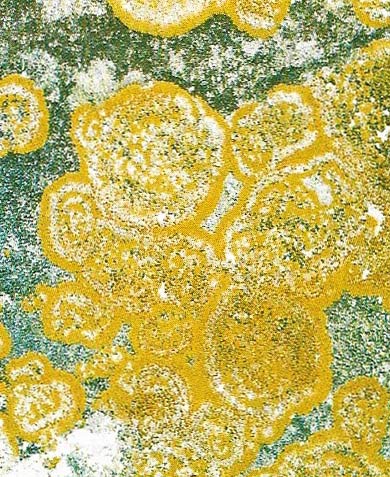
Figure 2. Encrusting lichens cling close to the surface to which they attach themselves. The species shown here is Caloplaca heppiana. It is frequently to be found growing on walls and tombstones. (This and similar species of lichen can be used for dating purposes.) Such lichens are often brightly colored – the pigment being derived from the fungal partner.
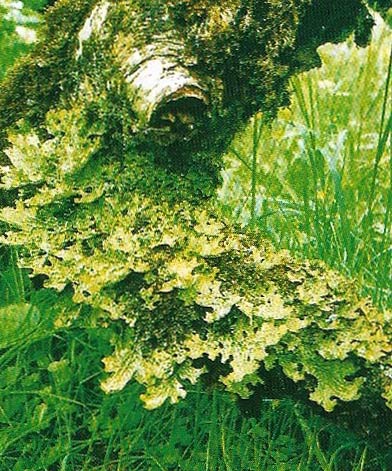
Figure 3. A typical leafy lichen is the tree lungwort (Lobaria pulmonaria), one of 70 species which are mostly subtropical. The tree lungwort occurs in the northern temperate zone. Its "leaves" can grow to lengths of 10 centimeters (4 inches). When wet they are bright green; when dry, yellowish-brown. Reproduction is by means of spores produced in cup-shaped structures on the "leaf" structure.
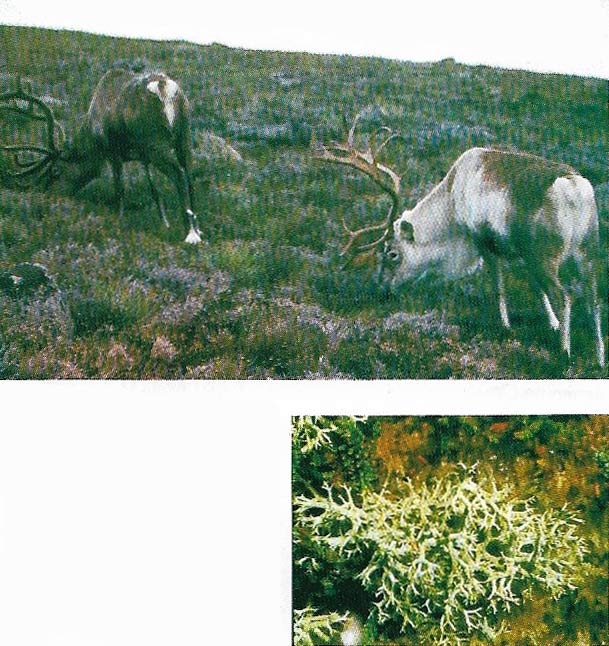
Figure 4. Reindeer moss (Cladonia rangifera) (B) is the staple diet of reindeer (A) in the long months of the Arctic winter when here is little other green vegetation available for consumption. Other deer and musk oxen also graze large quantities of it. Lichens contain a high proportion of carbohydrates which provide the large amounts of energy required in such extreme conditions. However, lichens are low in other nutrients. A diet based exclusively on lichens produces symptoms of protein deficiency. In Scandinavia some species of Cladonia are used to make alcohol and sugar.
A lichen is a symbiotic relationship between a fungus and an alga and/or a cyanobacterium. Every lichen (pronounced 'like-en', not 'litch-en') consists of a fungus, which usually makes up the main body or thallus, and an alga and/or a cyanobacterium, whose cells grow in among the threads or hyphae of the fungus (Figure 1). The alga and/or cyanobacteria, which possesses chlorophyll and carries out photosynthesis, does most of the work, producing simple sugars and vitamins for the lichen's collective metabolic pathways. The fungal cells absorb nutrients from water, give the lichen a definite structure, and protect the algal or bacterial cells from environmental extremes.
 |
| Lichen is actually two types of organism, rolled into one – the alga/cyanobacterium provides the fungus with food while the fungus offers the alga a living environment. Image: L Sancho. |
The fungus is usually one of the Ascomycetes (sac-fungi) that produce spores in closed sacs. The algal partner is a green alga (Chlorophyta) or a cyanobacterium (Cyanophyta). With few exceptions, a lichen is the product of a single species of fungus and a single species of alga or cyanobacterium. The most common alga (found in more than 50 percent of lichens) is the single-celled green alga Trebouxia. Many of the algae/cyanobacteria can, and do, exist separately in nature, but the fungi have never been found alone.
Lichen are generally low-growing, vary in color from bright orange or yellow to gray or black, and are often found growing on rocks and tree bark. Although found throughout the world, they're unable to survive where the atmosphere is polluted so are good indicators of clean air.
 |
| Rhizocarpon geographicum |
The dual nature of lichens was first realized in 1867 by a Swiss naturalist called Schwendener.
Distribution
Lichens can adapt themselves to almost any kind of surface. They will grow on sun-baked rock in arid deserts, on the backs of weevils, or in the bleached skulls of dead animals. One species (Verrucaria serpuloides) is continually submerged in freezing Antarctic waters; another (Lecanora esculenta) travels on the wind. And although lichens are on the whole highly sensitive to industrial pollution, Leconora conizaeoides actually increased in areas of high industrial pollution. In fact, by mapping lichens it is possible to pinpoint areas of high and low pollution in a given region and to assess what importance factors such as wind direction, elevation, and ground shape have on the sources of pollution.
Classification of lichen
About 15,000 species of lichen are known and vary greatly in both size and appearance. Some have filaments that reach lengths of 2.75 m (9 ft) or more, while other are smaller than a pinhead. They are classified into three main groups according to the way in which they grow:
• Fruticose (stalked). The thallus is bushy and branching, attached
only at the base, and stands out or hangs down from the surface it grows
on. This type can absorb water in the form of vapor and is particularly suited to humid climates
• Foliose (leafy). The lichen creeps over the surface, but
can easily be detached from it (Figure 3). This type flourishes in regions where the rainfall is heavy
• Crustose (crust-forming). Lichens of this type (Figure 2) are closely applied
to rock or bark, and cannot be removed from it except by brushing or
scraping. Some of them look rather like dried paint. Crustose lichen are resistant to drought and prevail in deserts.
The role of fungus and alga in a lichen
The alga or cyanobacterium component of a lichen manufactures its food by photosynthesis – the conversion of carbon dioxide and water in the air into carbohydrates by exposure to light. The simple carbohydrate formed in the fungal layer is excreted, absorbed by the fungus, and transformed by it into a different carbohydrate. This carbohydrate flow is the basis of the symbiotic relationship developed in the lichen. The transfer of nutrients from alga to fungus is swift: fungi have been found to convert sugars derived from algae into fungal products within three minutes of the start of photosynthesis. The alga may also provide the fungus with vitamins and stimulate the growth of the lichen. For its part, the fungus takes in water vapor, which accelerates the rate of photosynthesis in the alga, while the fungus provides shade for the alga underneath – some algae such as Trebouxia – dislike strong light.
Reproduction and growth of lichen
Lichens are reproduced by minute, dust-like spores, which are carried in the air and germinate if they fall in a suitable place. The spores come from the fungus, and are like those of ordinary fungi; the alga plays no part in their production. These spores will grow into fungi if they are cultured on nutrient jelly; in nature they germinate as fungi, but will not continue to grow unless they encounter suitable cells from the many algae which grow independently. The spores of a lichen are usually produced in a small, cup-like structure called an apothecium. Some lichens also reproduce by producing little powdery granules, consisting of a scrap of fungus hyphae with some alga cells entangled in them. Such a granule is called a soredium, and can grow into a new lichen.
Lichens are extraordinarily slow-growing, and are also among the longest-lived plants. This applies especially to the encrusting, or crustose, lichens that grow on rocks. The thallus of Rhizocarpon geographicum increases about 2 cm in diameter over 100 years; patches found growing on rocks in the arctic regions must, by their size, be many hundreds of years old. There seems no reason why they should not go on growing indefinitely. Although the rate of growth is very slow it is quite constant and this fact has been used to estimate minimum ages for glaciers, ancient monuments, and other objects.
Uses of lichens
Lichens are of great importance in soil formation. By breaking down the rock surfaces they pave the way for mosses and higher plants. In cold regions like the tundra they are important as food for animals such as reindeer and caribou. The Reindeer moss of Lapland (Figure 4) is fruticose lichen of the genus Cladonia.
In the past, lichens have been a valuable source of permanent dyes but this industry has been replaced by the synthetic dyes. Litmus, the indicator used to show acidity or alkalinity in the laboratory, was originally obtained from a lichen.
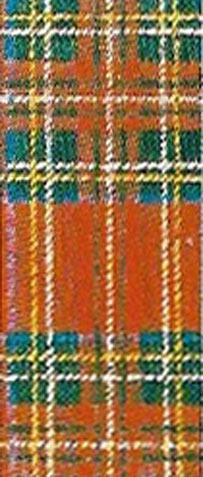 |
| Lichen extracts were once used to color the cloth for Scottish kilts. The lichens colored the cloth yellow, brown, red, and purple. Intermediate colors were obtained by overdyeing. |
Lichens in space
Lichens are the most complex form of life known to have survived prolonged exposure to space. In an experiment led by Leopoldo Sancho from the Complutense University of Madrid, two species of lichen – Rhizocarpon geographicum and Xanthoria elegans – were sealed in the Foton M2 capsule and launched on a Russian Soyuz rocket on 31 May 2005, from Baikonur Cosmodrome. Once in Earth orbit, the lid of the container opened and the samples were exposed to the space environment for nearly 15 days before the lid resealed and the capsule returned to Earth. The lichens were subjected to the vacuum of space, unshielded solar ultraviolet radiation, and temperatures ranging from –20°C on the night side of the Earth, to 20°C on the sunlit side. Surprisingly, they survived apparently unscathed.
In space, the lichens became dormant and did not metabolize. However, back on Earth, they resumed their normal activity and their DNA appeared not to have been damaged. All of the lichen appeared to endure the ultraviolet radiation, even those receiving the most exposure. Lichens have a tough mineral coating that could shield them from UV rays. They are also made from individual organisms layered on top of one another, so outer layers may provide protection for underlying cells.
The experiment adds weight to the theory of panspermia – that life could be transported between worlds, perhaps by hitching a ride on an asteroid. It also indicates that organisms similar to lichens might be able to survive on the surface of Mars. Although the martian atmosphere is very thin, it is composed mainly of carbon dioxide, which is necessary for lichens' photosynthesis. The lichens might not survive on Mars for long, however, because of low oxygen levels in the atmosphere.
In the 1980s, experiments carried out on NASA's Long Duration Exposure Facility satellite showed that certain bacteria are hardy enough to endure space.

