
M87 (NGC 4486)
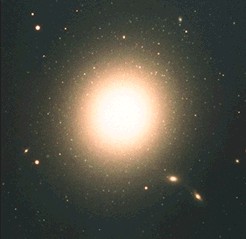
Figure 1. The giant elliptical M87.
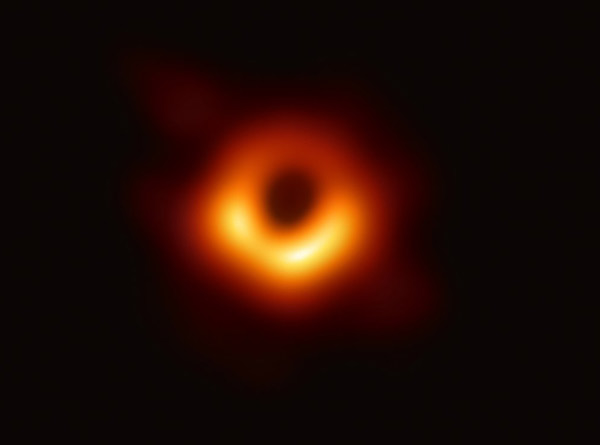
Figure 2. Image of the black hole at the center of M87 obtained by the Event Horizon Telescope. Credit: EHT Collaboration.
M87 (NGC 4486) is a giant elliptical galaxy in the Virgo Cluster, of which it is probably the dominant member. M87 has a diameter of at least 120,000 light-years – greater than that of the Milky Way's disk. As M87 is nearly spherical (type E0 or E1 in Hubble's classification), it fills a far larger volume than does our own galaxy, and thus contains many more stars. Its mass has been estimated at 2 to 3 trillion solar masses (Figure 1).
| visual magnitude | 8.6 |
| apparent size | 7' |
| distance | 60 million light-years |
| position | RA 12h 31m, Dec +12° 24' |
M87 was identified with the strong radio source Virgo A by Walter Baade and Rudolph Minkowski in 1954. It is also a powerful source of X-rays, and sits near the center of a hot, X-ray emitting cloud that extends over vast reaches of the Virgo Cluster.
A study by David Malin of the Anglo-Australian Observatory showed that M87 extends further than the previously-known spherical region into a vast elongated shape more than half a million light-years wide. Its outer layers are noticeably distorted, probably because of gravitational interactions with other Virgo Cluster galaxies and because of material acquired during cannibalistic encounters.
M87 contains over 10,000 globular clusters – including one of the largest ever seen – compared with the Milky Way's 150 to 200. It also boasts a spectacular jet that extends over 5,000 light-years from the center and consists of a string of knots and clouds of gas ejected from the core. A second, less-conspicuous jet points in the opposite direction. Images of the violent active nucleus of M87, taken with the Hubble Space Telescope, have revealed a central object of about 2 to 3 billion solar masses concentrated within a spherical region just 60 light-years across and surrounded by a rapidly rotating gaseous accretion disk. Almost certainly at the very heart of this object is a supermassive black hole weighing about 6.2 billion solar masses.
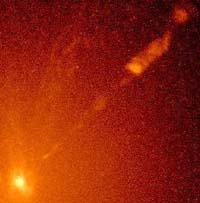 |
| Jet emerging from the core of M87. |
Peering into the black hole
In 2012, a team of astronomers published results obtained using observations from four linked radio telescopes which demonstrated virtually beyond doubt that the central black hole exists and provided some detailed information about it [1]. The researchers found that the high-speed jet emerging from the core of M87 originates within a region that is just 5.5 times larger than the estimated radius, or event horizon, of the black hole. Because the new measurement confines the massive central object in M87 to a tiny volume, the evidence for the existence of a supermassive black hole in the galaxy has become overwhelming.
In April 2019 researchers using the Event Horizon Telescope (EHT) announced that they had succeeded in obtaining direct visual evidence of the supermassive black hole at the center of M87 [2]. The image produced by the ETH shows the shadow of the black hole – the event horizon of the object being about 2.5 times smaller than the shadow and measuring just under 40 billion kiometers across (Figure 2).
References
1. Sheperd S. Doeleman, et al. "Jet-launching structure resolved near the supermassive black bole in M87". Science http://dx.doi.org/10.1126/science.1224768.
2. Akiyama, Kazunori, et al. "First M87 event horizon telescope results. IV. Imaging the central supermassive black hole." The Astrophysical Journal Letters 875.1 (2019): L4.
