
Muller, Hermann Joseph (1890–1967)
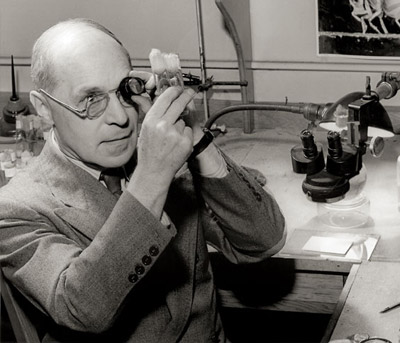
Hermann Muller was an American geneticist at Indiana University who was awarded the 1946 Nobel Prize in Physiology or Medicine for his work showing that X-rays greatly accelerate mutation processes in the fruit-fly (Drosophila). He thus highlighted the human risk in exposure to radioactivity.
Influenced by Troland's work, Muller suggested in 1929 that the first life-form on Earth may have "consisted of little else than a gene or genes."1 He later speculated on the differences and commonalities that might exist between higher life-forms on other worlds:2
[They] may be expected to have followed radically different courses in regard to many of their features... How much greater, then, might such differences be between the forms of Earth and those of another planet. These differences, affecting their whole internal economy, including the biochemistry within their cells, would also be expressed in their gross anatomy and in their outer form... [Even so] it would certainly be capable of achieving much mutual understanding with our own, since both had been evolved to deal usefully with a world in which the same physicochemical and general biological principles operate.
References
1. Muller, H. J. "The Gene as the Basis of Life," Proceedings of the International Congress of Plant Science, 1, 897 (1929). Reprinted in Studies in Genetics: The Selected Papers of H. J. Muller, Bloomington, Ind.: University of Indiana Press (1962).
2. Muller, H. J. "Life Forms to Be Expected Elsewhere than on Earth," The American Biology Teacher, 23, 74 (1961).

