
mutation
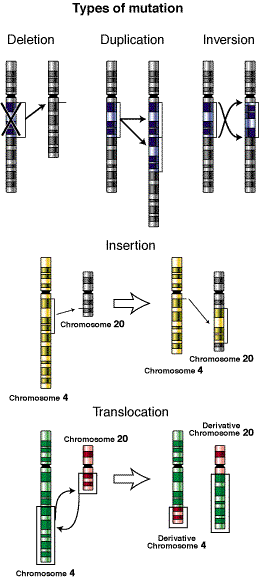
A mutation is a sudden, random change in the genetic material of a cell. It may include a change in the nucleotide sequence, alteration of gene position, gene loss or duplication, or insertion of a foreign sequence. Mutations in germ-line tissue are of enormous biological importance since they can produce an inherited change in the characteristics of the organisms developing from them and thus provide the initial material from which natural selection produces evolutionary change.
The majority of mutations involve changes in individual genes and are known as point mutations or gene mutations. Others, however, called gene mutations, involve gross structural alterations of chromosomes (e.g., inversion or translocation) or changes in numbers of whole chromosomes per nucleus (e.g., polyploidy).
Mutation is normally a very infrequent event, though it can be greatly speeded up by irradiation with X-rays, gamma rays, neutrons, etc., and by some chemicals (e.g., mustard gas). From the standpoint of adaptation of the organism, mutations are random. Evolution has occurred by natural selection of mutations, not directed mutation. They are merely the raw material for evolutionary change. The great majority of mutations are deleterious, upsetting the balanced mechanism of embryonic development of the organism; and on the whole the larger the change they induce the more deleterious they are.
Mutation in the restricted sense of gene mutation is a sudden change in an individual gene, probably the substitution of a different nucleotide for an existing one in the DNA, which alters the amino acid sequence of the protein normally dependent on that gene, with many possible repercussions in structure and function of the organism. The changed gene is allelomorphic to the old. It reproduces itself, in the changed form, many times (perhaps of the order of a million) before undergoing another mutation, which may be back to the original gene, or to a new allele. The same kind of gene mutation, i.e., a change from a particular allele to another particular allele, occurs repeatedly within a population of organism, probably over long periods of time. For example, in the human population the gene for hemophilia has arisen repeatedly by mutation from a normal allele. An entirely new gene mutation is therefore a much rarer event than the mutation rate would suggest.

