
mass extinction
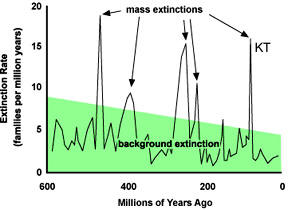
A mass extinction is an event in which large numbers of species, including entire genera, more-or-less suddenly vanish from the fossil record. Controversy surrounds exactly the number and timing of mass extinctions in Earth's history, though it is generally recognized that there have been at least six major ones. These occurred in the late Cambrian (500 million years ago), in the late Ordovician (440 million years ago), in the late Devonian (365 million years ago), at the end of the Permian (245 million years ago), in the late Triassic (208 million years ago), and at the end of the Cretaceous (65 million years ago).
A variety of causes have been proposed including sea-level changes, volcanic eruptions, ice ages, asteroid or comet impacts (see cosmic collisions, biological effects), and nearby supernovae.
| The five largest known mass extinctions | ||
|---|---|---|
| geological period | yr ago | notes |
| late Ordovician | 438 million | 100 families extinct, including more than half of all bryozoan and brachiopod species |
| late Devonian | 360 million | 30% of animal families extinct |
| end of Permian | 245 million | Trilobites extinct. 50% of all animal families, 95% of all marine species, and many trees die out |
| late Triassic | 208 million | 35% of all animal families die out, including most early dinosaur families and most synapsids, except for the mammals |
| Cretaceous-Tertiary boundary | 65 million | About half of all life-forms died out, including the dinosaurs, pterosaurs, plesiosaurs, ammonites, and many families of fish, snails, sponges, sea urchins |

