
NGC 2867
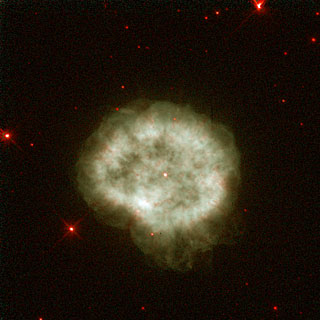
NGC 2867. Image: Hubble Space Telescope.
NGC 2867 is a planetary nebula in the southern constellation Carina, 1.2° north-northeast of the 2nd magnitude star Iota Carinae. NGC 2867 may be no more than 2,750 years old.1 It is unusual in being only one of a few dozen such objects known to have a Wolf-Rayet star (type WC6) as its central star.
NGC 2867 was discovered by John Herschel from Felhausen observatory at the Cape of Good Hope on April Fools Day, 1834 – appropriately enough as Herschel was almost fooled into thinking it was a new planet. Its size and appearance were certainly planet-like and it was only after careful checking that Herschel was convinced it was a nebula.
| visual magnitude | 9.7 |
| angular size | 0.4' |
| linear diameter | 0.45 light-year |
| distance | ~1,700 light-years (520 pc) |
| position | RA 09h 21m 25.3s, Dec -58° 18' 40.7" |
| other designations | ESO 126- 8, GCRV 6100, HD 81119, Hen 2-27, PK 278-05 1, PN G278.1-05.9 |
Reference
1. Meatheringham, S. J., Wood, P. R., and Faulkner, D. J. "A study of some southern planetary nebulae". Astrophysical Journal, 334, 862–874 (1988).

