
PSLV (Polar Satellite Launch Vehicle)
PSLV (Polar Satellite Launch Vehicle) is a four-stage Indian launch vehicle capable of placing a one-ton payload into polar orbit. Its development allows India to launch its own IRS (India Resource Satellite) missions, rather than relying on Russian launch services. The PSLV uses a four-stage core vehicle surrounded by six strap-on boosters of the type developed for the ASLV. At liftoff only two of the strap-ons and the bottom stage of the core vehicle are ignited. The other four boosters are fired at an altitude of 3 kilometers. The core vehicle is unusual in having two solid-propellant stages (1 and 3) and two liquid, hypergolic stages (2 and 4). The PSLV was first launched on 20 September 1993, became operational in March 1996, and has since successfully launched several payloads, including IRS-P4 (Oceansat) and two piggyback satellites, the Korean KITSAT and the German TUBSAT, on 26 May 1999. A second successful triple launch for PSLV took place on 22 October 2001, when the German BIRD, the Belgian PROBA, and the Indian TES satellites were placed into their correct orbits by the PSLV-3C mission (see accompanying photo of launch).
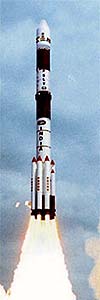 |
| PSLV-3C
|
| total mass | 294 tonnes |
| height | 44.4 m |
| maximum diameter | 2.8 m |
| payload to polar orbit | 1,000-2,000 kg |
| thrust | |
| first stage (+ 6 strap-ons) | 8,600,000 N |
| second stage | 724,000 N |
| third stage | 324,000 N |
| fourth stage | 14,800 N |

