
ASLV (Advanced Satellite Launch Vehicle)
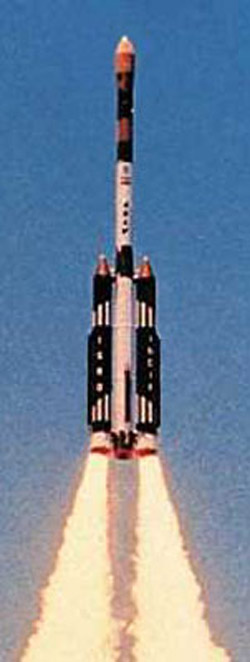
ASLV (Advanced Satellite Launch Vehicle) is an Indian launch vehicle derived from the SLV-3. The all-solid-propellant ASLV was created by adding two additional boosters modified from the SLV-3's first stage and by making other general improvements to the basic SLV-3 four-stage stack. In fact, it is a five-stage vehicle since the core first stage does not ignite until just before the booster rockets burn out.
The first launch of the ASLV, on 24 March 1987, failed when the bottom stage of the core vehicle did not ignite after booster burnout. The second attempt, on 13 July 1988, ended with the Rohini payload falling into the Bay of Bengal when the vehicle became unstable after release of the boosters. Finally, on 20 May 1992, SROSS-3 was inserted into low Earth orbit (LEO) by the third ASLV. However, instead of entering a circular orbit near 400 kilometers, the ASLV achieved only a short-lived orbit of 256 kilometers by 435 kilometers. The fourth ASLV mission in May 1994 successfully reached its programmed orbit of 434 kilometers by 921 kilometers with the SROSS C2 payload. The vehicle is likely to be phased out shortly in favor of the more powerful PSLV (Polar Satellite Launch Vehicle).
| thrust at liftoff | 910,200 N |
| mass, fully-fueled | 41,000 kg |
| payload to LEO | 150 kg |
| diameter | 1.0 m |
| length | 23.5 m |

