
SROSS (Stretched Rohini Satellite Series)
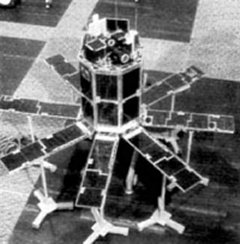
SROSS B.
SROSS (Stretched Rohini Satellite Series) were spacecraft developed by the Indian Space Research Organisation (ISRO) as follow-ons to the successful Rohini satellite series.
SROSS satellites, which measured 1.1 × 0.8 meters, were designed to carry small scientific and technology payloads, including astrophysics, remote sensing, and upper atmospheric monitoring experiments. They were launched aboard developmental flights of India's new ASLV (Advanced Space Launch Vehicle) from Sriharikota. Both SROSS 1 and SROSS 2 were lost due to launch failures. The third vehicle, SROSS C, was successfully placed in orbit, but one much lower than planned. The vehicle decayed on 14 July 1992, and although it returned some scientific data was deemed only partially successful. SROSS C2 was the first unqualified success of the SROSS and ASLV programs. SROSS C and C2 carried a gamma-ray burst (GRB) experiment that monitored celestial gamma-ray bursts in the energy range 20–3,000 keV, and a Retarded Potential Analyzer (RPA) experiment that measured temperature, density, and characteristics of electrons in the ionosphere.
| spacecraft | launch date | orbit | mass (kg) |
| SROSS A | Mar 24, 1987 | launch failure | 150 |
| SROSS B | Jul 12, 1988 | launch failure | 150 |
| SROSS C | May 20, 1992 | 251 × 436 km × 46.0° | 106 |
| SROSS C2 | May 4, 1994 | 437 × 938 km × 46.2° | 113 |

