Pandora
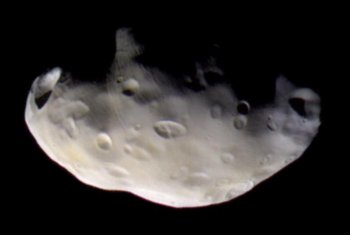
Image of Pandora by Cassini.
Pandora is one of the inner moons of Saturn and the outer shepherd moon for the F-ring. It was discovered in 1980 from Voyager 1 photos and is also known as Saturn XVII.
Pandora is heavily cratered and, as revealed by the Cassini probe during its passage of the moon at a distance of 52,000 kilometers on 5 September 2005, there are small grooves and ridges in the dust-fine icy material that has collected over the craters. The two largest craters identified measure about 30 kilometers (19 miles) across.
Pandora and Prometheus, the inner shepherd of the F-ring, both follow chaotic orbits as a result of their gravitational interaction. Each time Pandora passes inside Prometheus, which happens about every 28 days, the two moons give each other a gravitational kick. Because neither moon's orbit is quite circular, the distance between them on those occasions – hence the strength of the kick - varies. The perturbations lead to changes in motion that are not periodic or predictable. This is the first observation ever of chaotic orbital motions in the Solar System. A larger moon of Saturn, Hyperion, had earlier been found to have chaotic rotation around its axis.
| discovery | 1980, by S. Collins from Voyager 1 data |
| semimajor axis | 141,720 km (88,080 mi) |
| diameter | 103 × 80 × 64 km (64 × 50 × 40 mi) |
| mean density | 0.5 g/cm3 |
| escape velocity | 0.019 km/s (68 km/h, 43 mph) |
| orbital period | 0.629 days (15 h 6 min.) |
| orbital eccentricity | 0.004 |
| orbital inclination | 0.05° |
| visual albedo | 0.6 |