
Prometheus
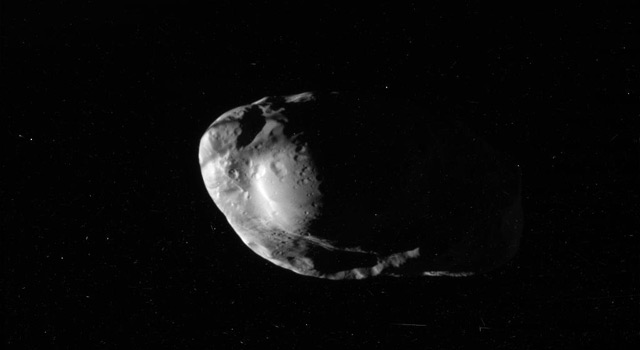
Prometheus as imaged by Cassini on 27 January 2010 from a distance of 36,000 kilometers.
Prometheus is one of the small, inner moons of Saturn. It was discovered in 1980 from photos taken by Voyager 1 and is also known as Saturn XVI.
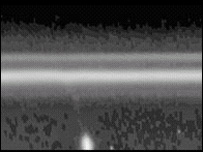 |
| A faint stream of material appears to connect
the F ring to Prometheus, the white blob at the bottom, in this
image taken by Cassini in Jul 2004.
|
Prometheus and Pandora act as shepherd moons for the inner edge of Saturn's F-ring. Prometheus is extremely elongated and has a number of ridges and valleys on its northern side. Although craters up to 20 kilometers (12 miles) wide mark its icy surface, it appears to be less heavily cratered than its neighboring moons Pandora, Janus, and Epimetheus. Its low estimated density suggests that it may be a porous, icy body.
| discovery | 1980, by S. Collins et al |
| semimajor axis | 139,353 km (85,590 mi) |
| diameter | 119 × 87 × 61 km (74 × 54 × 38 mi) |
| mean density | 0.5 g/cm3 |
| escape velocity | 0.019 km/s (68 km/h, 43 mph) |
| orbital period | 0.613 days (14 h 43 min) |
| orbital eccentricity | 0.002 |
| orbital inclination | 0.01° |
| visual albedo | 0.6 |
Prometheus is a volcano on Io known as the Jovian moon's "Old Faithful." Prometheus has been active
during every observation of it since it was first seen by Voyager 1,
though its plume, which is 80 kilometers tall, has migrated about 85 kilometers to the
west.
See also Project Prometheus.

