
Operation Paperclip
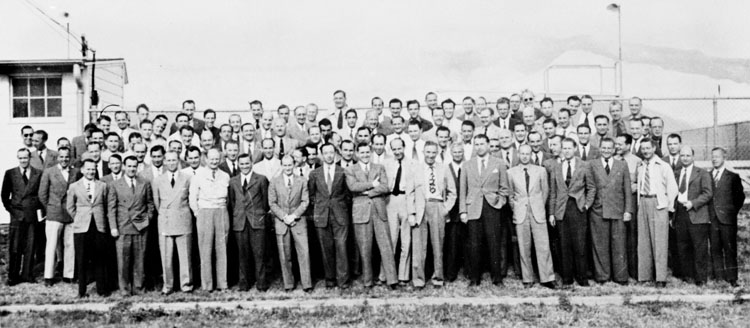
The Operation Paperclip crew. Von Braun is the tall figure in the front row, right of center.
Operation Paperclip was the code-name of the American scheme to detain top German scientists and engineers at the end of World War II and relocate them to the United States. It was originally called Operation Overcast. The scientists included Wernher von Braun and more than 100 of his colleagues who had worked on the V-2 and other "V" weapons. These personnel and the hardware that came with them formed the backbone of the early American space program.
Origins of Paperclip
In May 1945, after the fall of the Nazi regime, Russian soldiers secured the German atomic research laboratories at the prestigious Kaiser Wilhelm Institute in the suburbs of Berlin, giving Stalin the foundations of what would become a vast Soviet nuclear arsenal. Meanwhile, US forces removed V-2 missiles from the labyrinthine Nordhausen complex, built under the Harz Mountains in central Germany, just before the Soviets took over the factory, in what would become their area of occupation. And the team which had built the V-2, led by von Braun, also fell into American hands.
Shortly afterward Major-General Hugh Knerr, deputy commander of the US Air Force in Europe, wrote: "Occupation of German scientific and industrial establishments has revealed the fact that we have been alarmingly backward in many fields of research. If we do not take the opportunity to seize the apparatus and the brains that developed it and put the combination back to work promptly, we will remain several years behind while we attempt to cover a field already exploited."
Thus began Operation Paperclip, the exercise that saw von Braun and more than 700 others spirited out of Germany from under the noses of the United State's allies. Its aim was simple: "To exploit German scientists for American research and to deny these intellectual resources to the Soviet Union."
Hidden truths
President Truman authorized Paperclip in August 1945 and, on 18 November, the first Germans reached America. Truman, however, had insisted that anyone found "to have been a member of the Nazi party and more than a nominal participant in its activities, or an active supporter of Nazism militarism" be excluded. Under this criterion even von Braun himself would have been ineligible to serve the US. A member of numerous Nazi organizations, he also held rank in the SS. Among his senior associates were Arthur Rudolph, chief operations director at Nordhausen, where 20,000 slave laborers died producing V-2s; Kurt Debus, a rocket launch specialist and SS officer whose report stated: "He should be interned as a menace to the security of the Allied Forces;" and Hubertus Strughold, later called "the father of space medicine," whose subordinates had conducted human experiments at Dachau and Auschwitz, where inmates were frozen and put into low-pressure chambers, sometimes until they died. All of these men were cleared to work for the US, their alleged crimes covered up and their backgrounds glossed over by a military which saw winning the Cold War as its all-consuming priority.
Arrival in the United States
The first Paperclip group of seven scientists, headed by von Braun, arrived at Boston's Fort Strong on 29 September 1945. Before this group departed from Germany, von Braun spent two weeks in Britain, where he was questioned by Sir Alwyn Crow and other Ministry of Supply officials. After processing, six of the seven scientists went to Aberdeen Proving Ground, where they began sorting out the tons of documents that had been shipped from the Dörten Mine in Germany. Von Braun, who was met by Major James P. Hamill in Boston, stopped in Washington to meet with several high-ranking Army Ordnance officers, while the other members of the vanguard group – Erich W. Neubert, Theodor A. Poppel, August Schultze, Eberhard Rees, Wilhelm Jungert, and Walter Schwidetsky – went directly to Aberdeen.
Hamill began arranging to transfer the scientists to El Paso, Texas, where they were to start establishing a United States guided-missile program of Fort Bliss. The main body of Germans began arriving at Fort Bliss in December 1945, and by February 1946 over a hundred were on hand. They were quartered in converted buildings that gradually became more homelike.
The test facilities became more elaborate as the program picked up speed. The first static firing test of a V-2 power plant in the United States took place on 14 March 1946, and soon afterward a series of test flights began. The first American-adapted V-2 was flown from the White Sands Proving Ground, New Mexico, on 16 April 1946. For further information about the work of the Paperclip crew and US testing of the V-2, see the V-2 entry.

