
V-2

V-2 being launched.
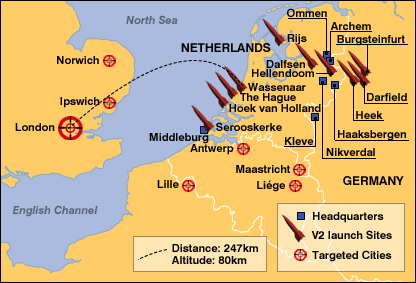
V2 launch sites (some omitted for clarity). Credit BBC.
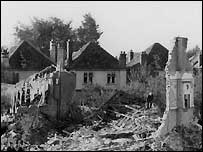
Staveley Road, Chiswick, England after a V-2 strike.


Photo taken from a V-2 of New Mexico just north of the White Sands launching site.
The V-2 was a 13.5-ton rocket, used as a guided missile, that carried a one-ton explosive charge. The liquid-fueled V-2 was the first large military rocket and the immediate ancestor of the launch vehicles used at the dawn of the Space Age. It was guided by an advanced gyroscopic system that sent radio signals to aerodynamic steering tabs on the fins and vanes in the exhaust. Its propellants – alcohol (a mixture of 75% ethanol and 25% water) and liquid oxygen – were delivered to the thrust chamber by two rotary pumps, driven by a steam turbine.
Development of the V-2
The V-2, or A-4 as it was initially known, was the ultimate development of the "A" series of German rockets. The original design for the missile had been prepared before the war by a team headed by Walter Dornberger and Wernher von Braun team at the Army Experimental Station at Peenemünde. During 1938 and 1939, a smaller version of the missile, the A-5, was fired with considerable success. The launches totaled at least 25 by 1940.
While the A-5 flights went ahead, components were designed and developed for the much larger A-4. By the spring of 1939, some A-4 components were actually in production, and the rocket's design had been frozen, Walter Riedel in charge of the design offices. Manufacturing and assembly techniques were being developed under the direction of Eberhard Rees. Rudolf Hermann had supervised the construction of a supersonic wind tunnel in 1936–1937, and vitally needed aerodynamic data had been obtained from it. Guidance and other related electronics problems were being solved under the scientific supervision of Hermann Steuding and the engineering direction of Ernst Steinhoff. The first static tests of the A-4 engine took place in 1940. By 1942, the first missiles were coming out of the Peenemünde model shops.
The first firing was on 13 June 1942, but it was a failure. Immediately after launch, the propellant feed system failed, and the huge A-4 went out of control and crashed. A second, not entirely successful, test on August 16 chalked up one notable achievement: A-4 No. 2 was the first guided missile to exceed the speed of sound.
The third launching, on 3 October 1942, was a complete success. The engine burned for nearly one minute, giving the A-4 a range of just under 120 miles and a maximum altitude of over 50 miles. Later that evening at dinner, Walter Dornberger said: "We have invaded space with our rocket and for the first time – mark this well – have used space as a bridge between two points on the Earth.. This third day of October 1942, is the first of a new era of transportation – that of space travel."
Hitler, who had not seemed impressed with the potential of rockets when he viewed the test-firings of two engines at Kummersdorf in 1939, suddenly became interested in what was happened at Peenemünde. A V-2 production committee was established in the Ministry of Armaments and War Production with Gerhard Degenkolb as director. It was not entirely a blessing. As von Braun wrote later: "The committee immediately began issuing high-handed directives and setting up a mighty production organization. Mainly composed of men of little scientific judgment, although of vast energy, this committee was thorn in the side to Peenemünde." Despite this interference, hundreds of V-2s were manufactured and fired over the next two years to prove systems, train troops, and acquaint the military with the operational characteristics of the weapon.
Production and deployment of the V-2
Production of the V-2 began in a new plant built a few miles south of Peenemünde Experimental Center. After the 17 August 1943 air raid by the RAF, which damaged this assembly plant badly, V-2 production was taken away from Dornberger and moved to a massive network of underground tunnels near Nordhausen in the Harz Mountains, an SS facility called the Mittelwerk (a converted oil depot). Nearly 900 V-2s a month were being produced there near the end of the war. Assembly plants under preparation near Vienna, Berlin, and Fridrichshafen were also closed and their equipment shifted to the Mittelwerk plant when it became evident that the secret was out. (The British got hold of a V-2 that had strayed from its course and landed near Kalmar, Sweden, in June 1944. As chance would have it, that particular shot was intended to test the radio-guidance system of a Wasserfall surface-to-air missile, and the British were misled into believing that the V-2 was radio-guided.)
V-2 components were produced in many parts of Germany. For example, the steam generator was made at Heinkel factory in Jenbach, Tyrol; the guidance system (with two free LEV-3 gyroscopes, leveling pendulums, and an integrating gyro-accelerometer) at Kreiselgeräte GmbH in Berlin; propellant containers at Zeppelin Luftschiffbau, Friedrichshafen. Many universities cooperated with Peenemünde during the program. Missile training was given at a school near Koeslin in Pomerania, and military proficiency firing took place on a former Polish Army reservation near Blizna.
A program of this magnitude inevitably had political aspects, General Dornberger and his military subordinates took care of most of the contacts Peenemünde had with Nazi party officials, but von Braun and his technical staff had to handle some of them. Until the end of 1943, the motivation for most of these contacts was curiosity on the part of the Nazi leaders, who had known little about Peenemünde's activities because of military security. But when it became obvious that the V-2 was going to be a spectacular new weapon, the SS began trying to take over the Peenemünde operation.
SS General Hans Kammler made the first attempt to take command of the Peenemünde base from Army General Leo Zanssen, but Dornberger stopped this effectively. The SS, however, kept trying. In February 1944, von Braun was called to Gestapo headquarters in East Prussia, where Heinrich Himmler tried to coerce him into deserting the army and working for him. Von Braun turned down the proposal and left. A few days later he was arrested by three Gestapo agents. After two weeks in a Stettin prison, he was charged by an SS court. He was accused of not being interested in war rockets but was working on space exploration, that he was opposed to the use of V-2s against England, and was about to escape to Britain in a small plane, taking vital rocket secrets with him. Dornberger went directly to Hitler and said that without von Braun there would be no V-2, after which von Braun was released.
One problem that had to be solved was whether the V-2 should be a mobile weapon. The technical people preferred a fixed launch site where loading, repairing, servicing, and last-minute adjustments could be handled under near-laboratory conditions. The military experts thought a mobile launching system would be best. In the end, both methods were tried. Massive concrete emplacements were started in France but never completed because of the Allied continual bombing attacks. The Peenemünde engineers had developed a mobile transporter and erector for the V-2, known as the Meillerwagon. It, along with rail transportation, became the standard method of transportation and launch. A typical trailer-mounted missile was supported by about 30 vehicles, including transportation trailer, launching platform trailer, propellant vehicles, and command and control trucks. A missile could be fired in four to six hours after a launch site was occupied.
V-2 assault
The V-2 assault got off to an inauspicious start on September 6, 1944, when two missiles were fired unsuccessfully against Paris. Two days later the V-2 offensive against southern England began. The first combat missiles were launched from a site near The Hague in the Netherlands at the rate of two a day.
On Friday evening, 8 September 1944, the first V-2s were fired in earnest, one of them creating a huge explosion and crater in Staveley Road, west London. After the explosion came a double thunderclap caused by the sonic boom catching up with the fallen rocket. Over the next seven months, about 2,500 V-2s were launched, 517 of them striking London and hundreds more exploding in counties around the capital and Allied-held parts of France, Belgium, and Holland. If everything functioned properly there was no defense against the missile. It dropped down on its target at 3,500 mph just five minutes after taking off.
But a myriad of things could go wrong with the complex missile, even if the launch went as planned – and it often didn't. The guidance system could fail, causing the V-2 to miss its target. The missile could explode on its journey out of the atmosphere or break up as it returned to Earth. Even if the target was reached, the warhead could turn out to be a dud. But the V-2s took their toll, killing more than 2,500 people and causing a great deal of property damage.
The V-2 offensive ended on 27 March 1945, nearly seven months after it began. The Germans could no longer provide support for weapon that clearly was going to neither influence the war's outcome nor delay its end. By April 1945, the German rocket batteries were in retreat before the advancing Allied armies. When it became obvious that Germany was facing collapse, Wernher von Braun agreed to surrender to the American Army as part of Operation Paperclip. Soon, he and his group, together with hundreds of V-2s and rocket components taken from the Mittelwerk, were on their way to the United States. See also V-1.
| Specifications of German wartime V-2 | |
|---|---|
| length | 46.1 ft (14.05 m) |
| diameter (max.) | 65 in (1.65 m) |
| launch mass | 27,000 lb (12,250 kg) |
| thrust at liftoff | 245,000 N (55,000 lb) |
| burn time | 65 s |
| max speed | 5,750 km/h |
| max altitude | 96 km |
| range | 200 mi (320 km) |
The V-2 at White Sands Missile Range
[Note: The following sections are adapted from a fact sheet provided by the US Army White Sands Missile Range]
In the closing days of the World War II, the United States embarked upon its own rocket development program and established White Sands Proving Ground (now White Sands Missile Range) in New Mexico as its principal site for rocket testing and development. To this site, in mid-August 1945, were delivered 300 railroad freight cars of V-2 components captured in the European Theater of Operations. Some of the components and material brought to White Sands included 215 combustion chambers, 180 sets of propellant tanks, 90 tail units, 100 sets of graphite jet vanes, and 200 turbopumps.
The widespread impression that many German missiles were brought to America intact and ready for flight was erroneous. No V-2s were received in flyable condition. The General Electric Company was contracted by the U.S. Army Ordnance Department to assemble, test and fire the V-2s.
US rebuilds German parts
Despite the abundance of V-2 material brought to White Sands certain components such as control compartment hardware were in short supply. For instance, only 50 control gyroscopes had been received from Germany, most of which were in poor condition. Each rocket required two gyroscopes. Another item which was found to be incomplete was a group of 70 electrical distribution panels with many of them missing wiring.
During the later stages of the firing program, General Electric provided gyros, mixer-computers, wiring, servo motors, and propellant piping to replace those German parts missing or which had deteriorated with age.
Major changes in configuration were made on 52% of the V-2s launched from White Sands Missile Range (WSMR), and 71% were above designed weight. Empty weight of the standard V-2 was 8,000 pounds which included 2,200 pounds of payload – warhead – and the average empty weight of all missiles launched was 9,218 pounds, an increase of 19% in terms of payload.
By 1951 all V-2s launched had major contour modifications and carried more than 47% added payload, bringing the maximum loaded weight to 28,400 pounds.
Assembling and testing V-2s were tedious jobs. Each rocket required days of preparation. All basic components were individually inspected for performance and condition prior to assembly. Repair and adjustments were made as required, and then they were tested again. Large subassemblies were completely tested before being installed and then the completely assembled missile was given two over-all tests before it left the assembly building.
After the V-2 was assembled and tested, a German-made trailer called the Meilerwagon towed it to the launch pad. An integral lift frame on the Meilerwagon elevated the rocket to a vertical position on a low portable steel "launch table". The table incorporated a blast deflector, a mast for electrical wiring, and fittings for liquid propellant hoses.
At the launching site, one over-all test was made prior to launching day, and the same test was repeated immediately prior to loading the propellant on firing day. No connection could be broken after the final test was made. Following a thorough check of all components, the rocket was fueled with alcohol and liquid oxygen.
Evolution of the V-2 program at White Sands
The first static firing test of a V-2 power plant took place on 14 March 1946, and soon afterward a series of test flights began. The first American-adapted V-2 was flown from the White Sands Proving Ground on 16 April 1946. Other flights of missiles equipped with instruments to test the upper atmosphere and ionosphere followed quickly.
To coordinate these experiments, a V-2 Upper Atmosphere Research Panel was established on 16 January 1947. As newer rockets were developed, the group became the Upper Atmosphere Rocket Research panel in March 1948 and the Rocket and Satellite Research Panel in April 1957. The group effectively coordinated the activities of government, industry, and universities in developing payload instrumentation and gathering and distributing data from the flights.
To support the V-2 flights, Army Ordnance contracted, as mentioned above, for the services of the General Electric Company in which became known as the Hermes program. While the components of the missiles flown in 1946 were largely of German origin, some, as indicated, had to be manufactured after the war. Also, increasing modifications were made from 1947 onward, primarily to accommodate larger and more complex payloads. By 1950 the V-2 rocket had been lengthened by 5 feet, increasing its payload capacity from 16 to 80 cubic feet.
The V-2 program, in addition to giving Americans expertise in launching large vehicles, gave valuable information on every aspect of rocket flights and added considerably to information about the upper atmosphere. Most of the rockets were flown from White Sands, carrying instruments that measured atmospheric characteristics and the ionosphere. A V-2 carrying atmospheric sounding gear and a biological payload reached an altitude of 116 miles on 17 December 1946. The highest altitude attained was achieved on 22 August 1951, when vehicle TF-1, with no scientific instrumentation, flew to 132 miles above the New Mexico desert. The longest V-2 flight in the United States, 111.1 miles, took place on 5 December 1946.
V-2 rocket components
The launch procedure included a final test of the rocket motor. Alcohol and liquid oxygen were allowed to flow into the combustion chamber by the force of gravity, where they ignited on contact. This produced approximately 16,000 pounds of thrust, too little to move the rocket but enough to check that the motor was functioning properly. The propellant turbine was then activated, increasing thrust to 52,000 pounds, enough to immediately initiate a launch. The V-2 had an overall length of 46 feet, diameter of 5 feet 5 inches, and a fin span of 11 feet 8 inches, its motor developed 52,000 pounds of thrust for 68 seconds, and its launching weight was 28,413 pounds, including 19,575 pounds of liquid propellant. The rocket consisted of five major parts:
Nose Cone - During World War II, the nose cone held a German warhead containing almost a ton of explosives. At White Sands, the Army invited government agencies and universities to use the nose cone's 20 cubic feet of space for scientific research, up to 2,000 pounds of scientific equipment, such as cameras, sensors, and on-board experiments, were carried aloft on each flight.
Control Section - This section contained gyroscopes for guiding the rocket in flight and the bottles of nitrogen gas that powered them. The gyroscopes produced electrical signals in the form of voltage proportional to the amount of correction needed to maintain a preset trajectory. The corrective signals were transmitted through an integrating computing element to steering vanes in the tail assembly.
Midsection - The propellant used in the V-2 consisted of alcohol and liquid oxygen, propellant tanks and associated valves and piping were located in the rocket's midsection. Glass wool insulated the rocket from the extreme cold of the liquid oxygen.
Thrust Frame - The thrust frame held the propulsion unit, which consisted of a turbopump, steam-generating plant, heat exchanger, combustion unit, and associated piping. The turbopump was powered by steam generated from combining hydrogen peroxide and sodium permanganate, both of which were stored in tanks in this section and forced into the pump by compressed air.
Tail Assembly - The tail served to stabilize flight and steer the rocket, and consisted of the tail faring, four stabilizing fins with steering vanes, vane motors, and antennas.
In the entire experimental program, 68% of the V-2 flights were considered successful. However, much valuable information was gained from flights with known malfunctions and classified as failures.
In all, 67 V-2 rockets were assembled and tested at White Sands between
1946 and 1952, providing the US with valuable experience in the assembly,
pre-flight testing, handling, fueling, launching, and tracking of large
missiles. The scientific experiments conducted aboard the V-2 yielded significant
information about the upper atmosphere, and one series of tests, the Blossom
Project, carried out the first biological experiments in space.
Landmark tests included:
Several offshoot programs developed from the V-2 experimental program. They were the Sandy, Pushover, and Bumper.
Operation Sandy was the code name for a project to test the feasibility of launching V-2s from the deck of an aircraft carrier. After several tests at White Sands on a simulated aircraft carrier deck to see what effects the rocket would have if it were to explode on the deck, the first and only launch of a V-2 at sea took place from the aircraft carrier Midway on 6 September 1947. With scientific observers on hand to witness the event, the fully fueled V-2 took off from the flight deck of the Midway from a location several hundred miles off the east coast of the US. The rocket traveled about 6 miles before exploding about 5,000 feet in the air and plunging into the sea. The program, conceived and realized by Rear Admiral Daniel V. Gallery, had obvious implications for the future – but meanwhile, the inherent hazards of shipboard launch had to be thoroughly investigated.
This led to Operation Pushover, directed by Lieutenant Commander W. P. Murphy, wherein to completely fueled V-2 rockets were purposely exploded to determine the extent of damage to the launch area occurring if an operational missile should inadvertently blow up. The information was vitally needed by the Navy, which was continuing to plan on launching large surface-to-surface bombardment missiles from ships of the fleet. Pushover was conducted using a dummy ship deck at White Sands in the late fall of 1948.
In late 1946 Army Ordnance started a development program leading to a two-stage rocket test vehicle. A WAC Corporal was mounted on the nose of a V-2 to form the first two-stage missile, known as the Bumper. The first Bumper was launched 13 May 1948.

