
Phoebus (nuclear reactors)
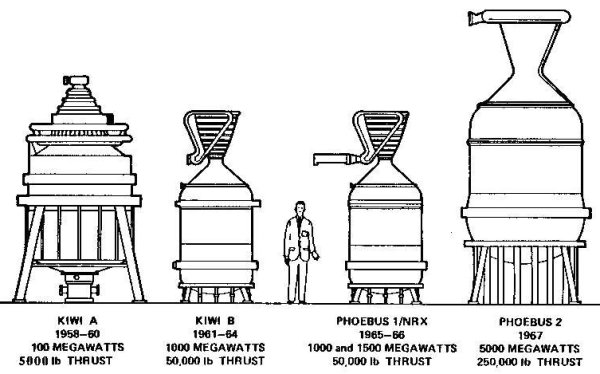
Comparison of the KIWI and Phoebus assemblies.
Phoebus was a series of nuclear reactors, designed and built in the 1960s as part of the Rover program, to meet the needs of an interplanetary mission (see nuclear propulsion), in particular a manned mission to Mars. The design requirements were a thrust of 250,000 pounds, a specific impulse (Isp) of 840 seconds, and a reactor power level of 5,000 megawatts.
The Phoebus-1 series was intended to study increasing the reactor power density and proved successful. When the power density was increased still further in the Phoebus-2 series, however, cooling of the aluminum pressure vessel was found to be a limiting factor. The Phoebus series demonstrated: 1) basic core and fuel configuration technology, 2) control of rocket parameters over a wide range of operating conditions, 3) the niobium carbide-molybdenum (NbC-Mo) coating could protect the fuel elements from hydrogen corrosion, 4) a two-pass regeneratively-cooled support structure allows full core performance, and 5) large nozzles for nuclear thermal rocket application were feasible. Other reactors developed during the Rover program were KIWI, Pewee-1, and Nuclear Furnace 1.
| Phoebus series summary | |||
|---|---|---|---|
| project | date | max. power (MWt) |
burn time (s) |
| Phoebus-1A | Jun 25, 1965 | 1,090 | 630 |
| Phoebus-1B | Feb 23, 1967 | 1,450 | 1,800 |
| Phoebus-2A | Jun 26, 1968 | 4,082 | 750 |
| Phoebus-2A performance parameters | |
|---|---|
| reactor power (MWt) | 4,082 |
| flow rate (kg/s) | 119.2 |
| fuel exit temp (K) | 2,283 |
| chamber temp (K) | 2,256 |
| chamber pressure (MPa) | 3.83 |
| core inlet temp (K) | 137 |
| core inlet pressure (MPa) | 4.73 |
| reflector inlet temp (K) | 68 |
| reflector inlet pressure (MPa) | 5.39 |
| periphery & structural flow (kg/s) | 2.3 |

