Poggendorff illusion
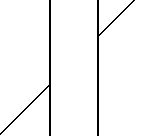
The Poggendorff illusion is a distortion illusion in which the two ends of a straight line passing behind a rectangle appear offset when, in fact, they are aligned. It was discovered in 1860 by the physicist J. C. Poggendorff, editor of Annalen der Physik und Chemie, after receiving a letter from the astronomer Friedrich Zöllner. In this letter, Zöllner described an illusion (see Zöllner illusion) he had noticed on a fabric design in which parallel lines intersected by a pattern of short diagonal lines appear to diverge.
 |
Reference
1. Gillam, B. "Geometrical Illusions." Scientific American, 242: 102–111 (January 1980).