
Purcell, Edward Mills (1912–1997)
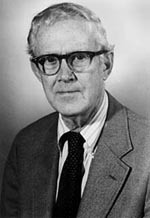
Edward Purcell was an American physicist at Harvard who shared with Felix Bloch (at Stanford) the 1952 Nobel Prize in Physics for his independent work on the nuclear magnetic moment, discovering nuclear magnetic resonance (NMR) in solids. Purcell was also the codiscoverer, with Harold I. Ewen, in 1951, of the 21-centimeter line of hydrogen.
In a lecture delivered at Brookhaven National Laboratory, in 1960, Purcell attacked the notion that interstellar travel would ever be possible, arguing that radio signals were probably the best way of establishing contact with other intelligent races.1 A similar discouraging outlook for flight between the stars was expressed by Pierce and von Hoerner.
 |
Reference
1. Purcell, Edward. "Radio Astronomy and Communication Through Space." In A. G. W. Cameron, ed., Interstellar Communication (1963).

