
phase
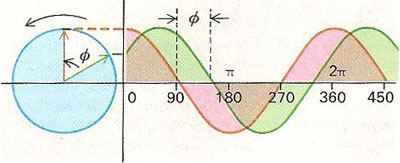
Two wave motions separated by a phase difference (φ), with their generating vectors. In this case the red wave leads the green wave by φ.
In the case of a wave, phase is the the position of the wave in its cycle at a specified time. It is a measure of whether the wave is at a crest, a trough, or at some point between. It is usually measured from an arbitrary starting point or compared with another motion of the same frequency. Phase is expressed as an angle (360° or 2π radians corresponding to a full cycle. Thus if an AC voltage is at its maximum value while the current is passing through zero, there is said to be a 90° (π/2) phase difference between them. Two waves are said to be "in phase" when their maximum and minimum values happen simultaneously. If not, there is a "phase difference", resulting in interference.
In the case of a sample of matter, a phase is a part that is in contact with other parts but is separate from them. Properties within a phase are homogeneous (uniform). Phases of matter should not be confused with states of matter, which refer to the differences between gases, liquids, solids, and plasma. Two regions in a chemical system that are in different states must also differ in their phases. However, the reverse is not true – a system can have multiple phases that are in equilibrium with each other and also in the same state of matter. For example, diamond and graphite (different allotropes of carbon) are both solids but they are different phases. A system with oil and water at room temperature will be two different phases of differing composition, but both will be in a liquid state. A phase diagram indicates the
In mathematics, the phase of a complex number is the angle between the real axis and a line from the number to the origin.
In astronomy, phase is the ratio of the lit to dark surface of the Moon or that of an inferior planet (i.e. Mercury or Venus). Changes of phase are caused by changes in the relative positions of Earth, the Sun, and the illuminated body. Conventionally, 0° phase occurs when the hemisphere facing Earth is fully sunlit. See also lunar phases.

