
planetary protection
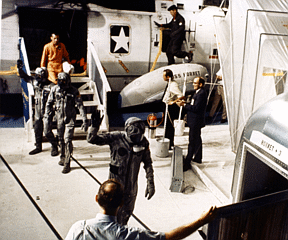
The Apollo 11 astronauts leave the recovery helicopter and walk across open deck before entering their quarantine chamber (lower right).
Planetary protection is a series of measures designed to protect Earth (see back contamination) and other bodies in the solar system (see forward contamination) from cross contamination. The need for planetary protection was first considered in 1958 (see Committee on Contamination by Extraterrestrial Exploration), was expressed in the Outer Space Treaty of 1967, and has been reconsidered and refined in the light or more recent developments. For many years, the Space Science Board has served as NASA's primary adviser on planetary protection and quarantine.
Apollo 11
Although NASA has long had procedures in place for handling and treating spacecraft that will land on other planetary bodies and, in some cases, return with samples to Earth, these procedures have not always been followed. The classic example of planetary protection measures not being followed or implemented well was Apollo 11 – the first manned vessel to return from the surface of the Moon. The remote possibility existed at the time that there might be organisms in the lunar soil which could be transferred to Earth with possibly catastrophic consequences. Although quarantine procedures had been put in place for the three returning astronauts, the Apollo capsule, and the lunar samples, these were either not adequate or were breached in several instances. First the capsule splashed down in the sea, affording the opportunity for any extremophilic organisms on the outside of the spacecraft to enter the ocean. Second the crane on the recovery ship which was supposed to winch the capsule and its crew aboard was not strong enough. Third, the collected lunar dust was much rougher than expected and had compromised the seals on the containers the crew had brought back. So the dust was scattered in the lunar module and capsule, making the open walk even riskier.
Mars landers and sample return missions
Great care was taken to sterilize the Viking landers that touched down on Mars in 1976. Each spacecraft was baked for four hours before launch to kill any terrestrial microbes adhering to them before launch. However, more recent landers and rovers, including Pathfinder, Spirit, and Opportunity have not been so rigorously cleansed. The discovery of the harsh conditions on Mars – its dryness, coldness, thin carbon dioxide atmosphere, and exposure to lethal ultraviolet – led to the requirement for absolute sterility being dropped. Also, the delicate coatings on the high resolution cameras of these later probes would have been destroyed by the heat of sterilization. The oven treatment will only be applied in future to spacecraft components, such as the Phoenix spacecraft digging arm, that bury into the Martian soil. Questions still remain unanswered about the ability of terrestrial extremophiles to survive current planetary protection protocols. It has been shown, in the light of what happened with Surveyor 3 that even ordinary Earth bacteria can survive for long periods under hostile space conditions.

