
RHESSI (Reuven Ramaty High Energy Solar Spectroscopic Imager)
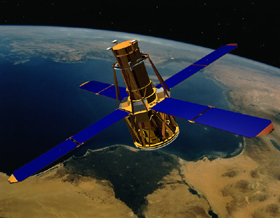
RHESSI (Reuven Ramaty High Energy Solar Spectroscopic Imager) is a NASA satellite designed to explore the basic physics of particle acceleration and energy release in solar flares. It carries out simultaneous, high resolution imaging and spectroscopy of flares from 3 keV X-rays to 20 MeV gamma rays with high time resolution. RHESSI, known originally as just HESSI, is the fourth SMEX (Small Explorer) mission. HESSI's launch by a Pegasus XL, scheduled for June 2001, was postponed following the loss of an X-43A experimental plane due to the failure of a similar Pegasus.
| launch date | Feb 5, 2002 |
| launch vehicle | Pegasus XL |
| launch site | Cape Canaveral |
| orbit | circular 600 km × 38° |
| mass | 293 kg |

