
Ryle, Martin (1918–1984)
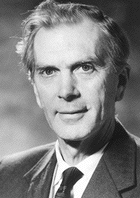
Martin Ryle was an English radio astronomer (the first professor of the subject in Britain) who shared the 1974 Nobel Prize in Physics with Anthony Hewish for the discovery of pulsars. He graduated from Oxford and helped develop radar for British defense during World War II before moving to the University of Cambridge, where he developed the technique of aperture synthesis and began a series of surveys of radio sources that were published as the Cambridge catalogues, the best known of which is the third (objects in it are preceded by the designation 3C). Ryle's counts of radio sources versus brightness supported evolving universe cosmologies, and he became a leading opponent of the steady state hypothesis. He was also an outspoken critic of attempts to communicate with intelligent extraterrestrials (see CETI, opposition). Ryle served as the Astronomer Royal from 1972 to 1982.
 |

