
Stephenson family
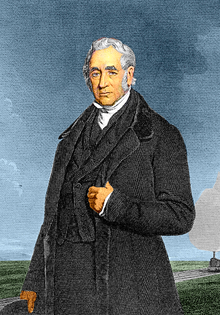
George Stephenson.
The Stephenson family was a British family of inventors and railroad engineers. George Stephenson (1781–1848) first worked on stationary steam engines, reconstructing one by Thomas Newcomen (c.1812). His first locomotive, the Blucher, took to the rails in 1814: it traveled at 4 mph (about 6.5 kilometers per hour) hauling coal for the Killingworth colliery, and incorporated an important development, flanged wheels. About this time, independently of Humphry Davy, he invented a safety lamp: this earned him £1,000 (the about $5,000), which helped finance further locomotive experiments. In 1821 he was appointed to survey and engineer a line from Darlington to Stockton: in 1825 his Locomotion carried 450 people along the line at a rate of 15 mph (about 25 kilometers per hour), and the modern railroad was born. This was followed in 1829 by the success of the Rocket, which ran the 40 miles (65 kilometers) of his new Manchester-Liverpool line at speeds of up to 30 mph (about 48 kilometers per hour), the first main-line passenger rail journey. See also early history of railways in Britain.
George's only son Robert Stephenson (1803–1859) helped his father on both of these lines, and with the Rocket, but is best known as a bridge builder, notably for the tubular bridges over the Menai Straits, North Wales (1850), and the St. Lawrence at Montreal (1859). He served as a member of Parliament from 1847,

