
spinal cord injury

Figure 1. Some of effects of injuries to different parts of the spinal cord.
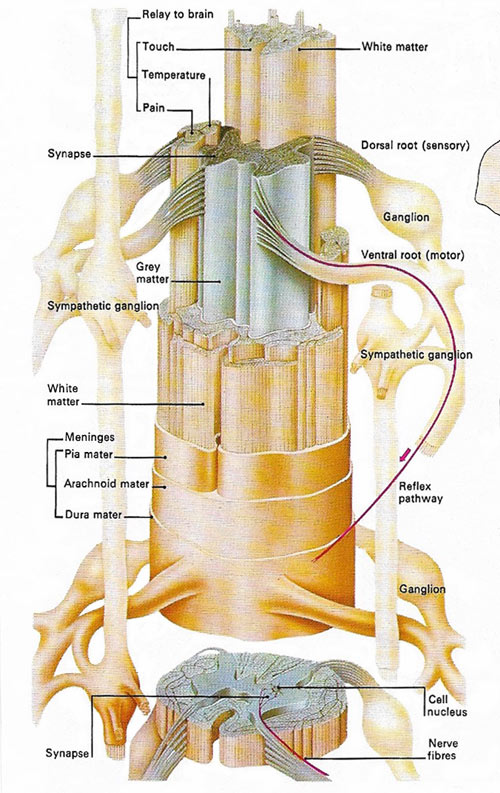
Figure 2. The sinal cord is made up of numerous bundles of nerve fibers carrying messages to and from the brain. The pathways cross so that sensations from one side of the body register in the cortex of the brain on the other side. The nervous system needs careful protection. The brain and cord are wrapped in tough membranes called meninges and bathed in a liquid called cerebrospinal fluid. This adds an effective watery cushion against jarring, as well as augmenting the supply of nutrients and oxygen provided by the blood. Most tracts of axons, except some of the autonomic system, are protected by a white, fatty substance called myelin. Cell bodies form the gray matter of the brain.
An injury to the spinal cord usually begins with a sudden, traumatic blow to the spine that fractures or dislocates vertebrae. The damage begins at the moment of injury when displaced bone fragments, disk material, or ligaments bruise or tear into spinal cord tissue. Most injuries to the spinal cord don't completely sever it. Instead, an injury is more likely to cause fractures and compression of the vertebrae, which then crush and destroy the axons, extensions of nerve cells that carry signals up and down the spinal cord between the brain and the rest of the body. An injury to the spinal cord can damage a few, many, or almost all of these axons. Some injuries will allow almost complete recovery. Others will result in complete paralysis.
Treatment
Improved emergency care for people with spinal cord injuries and aggressive treatment and rehabilitation can minimize damage to the nervous system and even restore limited abilities. Respiratory complications are often an indication of the severity of spinal cord injury. About one-third of those with injury to the neck area will need help with breathing and require respiratory support. The steroid drug methylprednisolone appears to reduce the damage to nerve cells if it is given within the first 8 hr after injury. Rehabilitation programs combine physical therapies with skill-building activities and counseling to provide social and emotional support.
Prognosis
Spinal cord injuries are classified as either complete or incomplete. An incomplete injury means that the ability of the spinal cord to convey messages to or from the brain is not completely lost. People with incomplete injuries retain some motor or sensory function below the injury. A complete injury is indicated by a total lack of sensory and motor function below the level of injury. People who survive a spinal cord injury will most likely have medical complications such as chronic pain and bladder and bowel dysfunction, along with an increased susceptibility to respiratory and heart problems. Successful recovery depends upon how well these chronic conditions are handled day to day.
Research
Advances in research are giving doctors and patients hope that repairing injured spinal cords is a reachable goal. Advances in basic research are also being matched by progress in clinical research, especially in understanding the kinds of physical rehabilitation that work best to restore function. Some of the more promising rehabilitation techniques are helping spinal cord injury patients become more mobile.

