
starburst galaxy
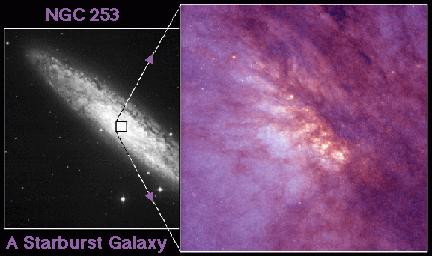
Figure 1. The starburst galaxy NGC 253, which lies about 8 million light-years away in the constellation Sculptor. Left: image taken with a ground-based telescope (credit: Jay Gallagher (University of Wisconsin-Madison), Alan Watson (Lowell Observatory), and NASA. Right: Hubble Space Telescope image of the core of NGC 253 revealing violent star formation within a region 1,000 light-years across.
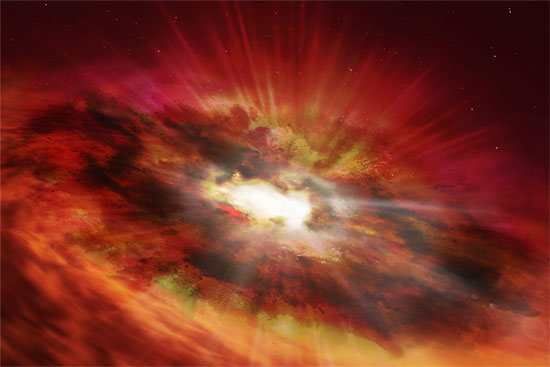
Figure 2. Artist's illustration of a supermassive black hole that is inside the dust-shrouded core of a vigorously star-forming starburst galaxy known as GNz7q. It will eventually become an extremely bright quasar once the dust is gone. The research team believes that the object, discovered in a Hubble deep-sky survey, could be the evolutionary "missing link" between quasars and starburst galaxies. The dusty black hole dates back to only 750 million years after the big bang.
A starburst galaxy is any galaxy in which star formation is taking place on an unusually large or rapid scale; specifically, a galaxy that is making stars so fast that it would convert all of its unconsolidated material into stars in a timescale, known as the exhaustion timescale, that is much less than the age of the universe. The nearest examples of starburst galaxies are NGC 253 (the Silver Coin Galaxy) and M82 (the Cigar Galaxy).
Where star formation occurs
In some cases, starburst galaxies have star-forming rates of hundreds of solar masses per year, corresponding to an exhaustion timescale of the order of 100 million years (about 1% the age of the universe). It follows that observed starbursts must have started in the relatively recent past. The burst may be galaxy-wide or confined to a small region, less than 1,000 light-years across, about the nucleus. Typically, much of the star formation occurs in very luminous, compact star clusters, 10 to 20 light-years across, with luminosities up to 100 million times that of the Sun. These clusters, known as ultra-luminous clusters are the most dense and intense star-forming environments known, and may be analogues of typical objects in the early epochs of galaxy formation. If they remain gravitationally bound after the mass loss from massive members is complete, they may eventually come to look a great deal like globular clusters.
Superwinds
The rapid rate of supernova explosions in starburst galaxies produces expanding bubbles of multimillion degree gas. When the starburst is sufficiently intense, it can create a superbubble so hot and energetic that it expands out of the galaxy in what is called a superwind.
Superwinds are thought to contain the carbon, nitrogen, oxygen, iron and other heavy elements dispersed by supernovas and spread these elements throughout the space between galaxies.
Signatures of starburst galaxies
Observationally, the overwhelming signature of starburst galaxies is intense emission in the far-infrared, caused by the ultraviolet emitted by numerous hot, young stars being absorbed by dust and reemitted at longer wavelengths. At these wavelengths, and to a lesser degree in the radio region, starburst galaxies rank second only to active galactic nuclei (AGN). The two types can readily be told apart, however: a compact, flat-spectrum radio source indicates an AGN, while more diffuse radio emission suggests a star-forming nucleus. Furthermore, AGN are more radio-loud and show high-ionization species, whereas the lack of these species combined with the presence of diffuse interstellar bands, due to molecules that are destroyed by the intense hard radiation in AGN, point to a starburst.

