
TOMS
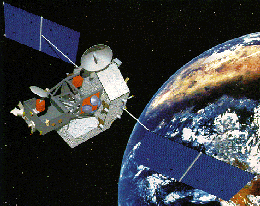
TOMS-EP.
TOMS (Total Ozone Mapping Spectrometer) is a NASA Earth-observing instrument that measures long-term changes in ozone concentrations to verify chemical models of the stratosphere and so help predict future climatic trends. The TOMS program is part of NASA's ESSP (Earth System Sciences Program). Various versions of TOMS have flown aboard Nimbus-7 (1978), a Soviet Meteor-3 (1991), TOMS-EP (1996), and ADEOS-1 (1996).
Originally intended for launch in 1994, TOMS-EP (Earth Probe) was delayed by failures of the first two Pegasus XL launch vehicles. As a result, TOMS-EP flew simultaneously with the ADEOS TOMS instrument (originally planned as TOMS-EP's successor). To prevent gathering redundant information, TOMS-EP was placed into an orbit lower than originally planned to obtain higher resolution measurements and data that was complementary to that gathered by ADEOS. When TOMS-EP began to show signs of premature aging, NASA ordered QuikTOMS as a gap-filler until ozone monitoring could be taken over by the EOS (Earth Observing System) Aura satellite in 2004. However, the fifth flight of TOMS ended in failure on 21 September 2001, when the Taurus rocket carrying the 162-kilogram QuikTOMS (and also OrbView-4 ) broke up less than 2 min after liftoff.
| TOMS-EP statistics | |
|---|---|
| launch date | Jul 2, 1996 |
| launch vehicle | Pegasus XL |
| launch site | Vandenberg Air Force Base |
| mass | 248 kg (total), 35 kg (TOMS alone) |
| orbit | 490 × 510 km × 97.4° |

