
Thomson, William (Lord Kelvin) (1824–1907)
William Thomson (Lord Kelvin) was a Scottish theoretical and experimental physicist, born in Ireland, who proposed the thermodynamic temperature scale (1848), now measured in kelvin, and inferred the so-called heat death of the universe based on an extrapolation of the second law of thermodynamics (heat cannot flow spontaneously from a cooler object to a hotter one).
Thomson estimated the age of Earth by calculating how long it would take for an Earth-sized ball of rock to cool from its initial molten state. His value – 20 to 400 million years – was much too low because he knew nothing about the heat still being generated inside our planet by radioactive decay. He also estimated the Sun's age, based on the most efficient energy source he could imagine, which was the slow release of gravitational energy by contraction (see Kelvin-Helmholtz contraction). Again, he had no way of knowing that, in nuclear fusion, there is a vastly more potent way of generating heat and light.
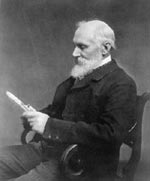 |
| I often say that when you can measure what you are speaking about,
and express it in numbers, you know something about it; but when you
cannot measure it, when you cannot express it in numbers, your knowledge
is of a meagre and unsatisfactory kind. – William Thomson, Popular Lectures and Addresses |
Thomson and Michael Faraday's work on electromagnetism gave rise to the theory of the electromagnetic field, and his papers, with those of Faraday, strongly influenced James Clerk Maxwell's work on the electromagnetic theory of light (though Thomson himself rejected Maxwell's abstract theory). His work on wire-telegraphic signaling played an essential part in the successful laying of the first Atlantic cable.
Thomson and panspermia
In his 1871 presidential address to the British Association for the Advancement of Science,1 Thomson surprised the scientific community by declaring his support for a version of the theory of panspermia:
Should the time come when this earth comes into collision with another body, comparable in dimensions to itself ... many great and small fragments carrying seeds of living plants and animals would undoubtedly be scattered through space. Hence, and because we all confidently believe that there are at present, and have been from time immemorial, many worlds of life besides our own, we must regard it as probable in the highest degree that there are countless seed-bearing meteoric stones moving about through space. If at the present instance no life existed upon this earth, one such stone falling upon it might, by what we blindly call natural causes, lead to its becoming covered with vegetation.
Witty and derisive replies were not slow in coming. That arch-supporter of Darwinism, Thomas Huxley (who ironically had introduced Thomson to the BAAS meeting) wrote in a private letter: "What do you think of Thomson's 'creation by cockshy' – God almighty sitting like an idle boy at the seaside and shying aerolites (with germs), mostly missing, but sometimes hitting a planet!" Thomson, however, continued to argue his case, even urging that he considered it "not in any degree antagonistic to ... Christian belief." Zöllner's attack on Thomson's thesis prompted a rebuttal from Helmholtz, who had independently put forward a similar theory of panspermia. In recent years, with the discovery of meteorites that have come from Mars, the concept of microbes hitching a ride from one world to another aboard impact fragments has become scientifically respectable (see ballistic panspermia).
Reference
1. Thomson, W. "Presidential Address to the British Association for the Advancement of Science," Nature, 4, 262 (1871).

