
tephra

Tephra erupted by Mount St. Helens on 18 May 1980 ranging in size from ash (left 2 piles) to lapilli (right 2 piles). Credit: D. Wieprecht / US Geological Survey.
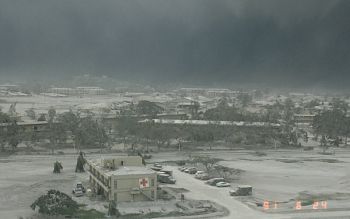
Volcanic ash falls to ground and creates darkness, Mount Pinatubo in the Philippines. Credit: E. Wolfe / US Geological Survey.
Tephra is a general term for fragments of volcanic rock and lava regardless of size that are blasted into the air by explosions or carried upward by hot gases in eruption columns or lava fountains. Tephra includes large dense blocks and bombs, and small light rock debris such as scoria, pumice, reticulite, and ash.
As tephra falls to the ground with increasing distance from a volcano, the average size of the individual rock particles becomes smaller and thickness of the resulting deposit becomes thinner. Small tephra stays aloft in the eruption cloud for longer periods of time, which allows wind to blow tiny particles farther from an erupting volcano.

