
transpiration
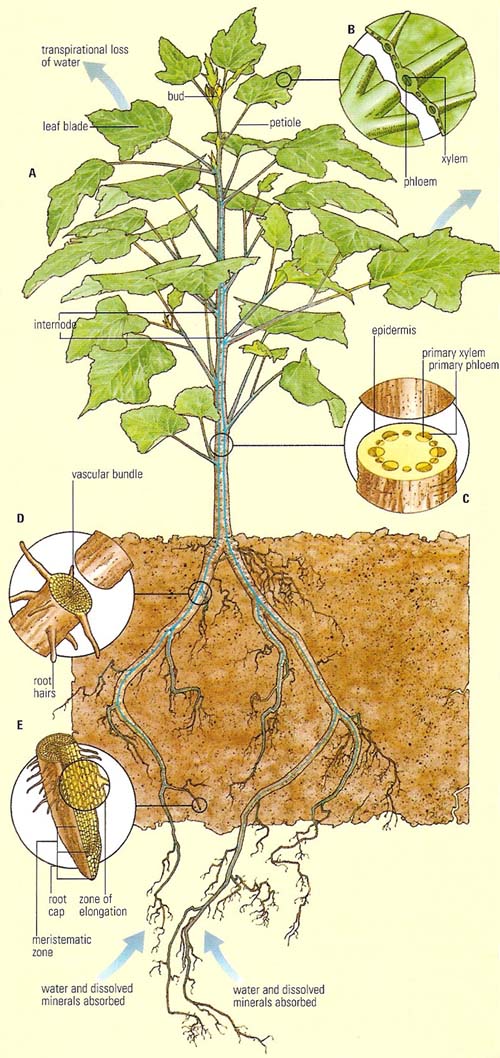
Transpiration in the context of overall plant structure and activity. The diagram of a plant (A) shows the tube-like cells used for transporting water and nutrients. The cells from the vascular bundles, which begin near the root tip, and run up the length of the stem and into the leaves. They consist of two main elements – the xylem and the phloem. The xylem carries water and dissolved mineral salts up through the plant to the leaf tissue, while the phloem carries sugars up and down the plant. The leaf of a dicotyledonous plant consists of two distinct parts – the petiole, or leaf stalk, which prevents the leaves bunching on the stem, and the blade. The cross-section of the leaf (B) shows how the veins, themselves vascular bundles, apart from carrying water and nutrients, also support the rest of the blade including mesophyll tissue, which contains chloroplasts vital for photosynthesis. The stem supports the plant and contains many vascular bundles (C). The roots (D) have thousands of tiny root hairs growing from them. As well as anchoring the plant in the soil, the root hairs also increase the surface area of the root system, thereby enabling the plant to absorb as much water and as many minerals as possible. The root tip (E) is divided into three sections. The root cap protects and lubricates the tip of the root, giving the growing roots a smooth passage through the soil. It is also the region in the root that perceives gravity and thereby controls the direction the root grows. The meristematic zone is where cells divide, adding new cells to the root cap below it, which is being permanently worn down and to the zone of elongation above it, the zone which aids the rapid growth of root length
Transpiration is the loss of water vapor by land plants. Most transpiration occurs through
the stomata of leaves and to a much lesser extent through the cuticle.
Transpiration differs from simple evaporation in that it takes place from living tissue and is therefore influenced by
the physiology of the plant.
Most of the water entering the roots of a plant is lost by transpiration.
The process is speeded up in light, warm, and dry conditions.
The flow of water from the roots to the stomata is called the transpiration
stream. Several forces drive this flow. As moisture evaporates from the
stomata, water moves in by osmosis from
adjacent cells, setting up a flow of water by osmosis across the leaf from
the xylem tubes to the stomata, pulling water
out of the xylem. The force of attraction between the water molecules as
they pass up the xylem tubes from the root to the leaves make it difficult
to break the water column. These tubes are also very narrow, so water rises
in them by capillary action. In
the roots, water being drawn into the xylem creates a lower concentration
of water in adjacent root cells, thus water is drawn across the root from
the root hairs by osmosis.

