
Voyager Interstellar Mission
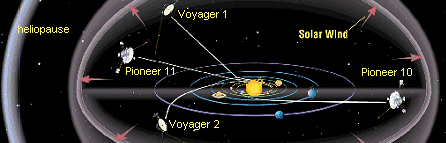
The Voyager Interstellar Mission (VIM) is an extension of the Voyager primary mission following the flyby of Neptune by Voyager 2 in 1989. The objective of the VIM is to extend NASA's exploration of the solar system beyond the neighborhood of the outer planets to the limits of the heliosphere, and possibly beyond. Data received from the two Voyagers (and Pioneer 10) into the first decade or two of the 21st century will be used to characterize the outer solar system environment and search for the heliopause boundary, where the solar wind meets the interstellar medium. Penetration of the heliopause by either or both spacecraft, while still active, would allow the first ever measurements to be made of the interstellar fields and particles. At the start of the VIM, the two Voyagers had been in flight for over 12 years. Voyager 1 was at a distance of approximately 40 astronomical units (6 billion kilometers, or 3.7 billion miles), and Voyager 2 at a distance of approximately 31 astronomical units (4.7 billion kilometers, or 2.9 billion miles).
Reference
1. Cesarone, R. J., Sergeyevsky, A. B., and Kerridge, S. Prospects for the Voyager Interstellar Mission, AAS/AIAA Astrodynamics Specialist Conference Paper 83–308, Lake Placid, N.Y., Aug. 22–25, 1983.

