
VY Canis Majoris

Figure 1. VY Canis Majoris is about 1,000 times wider than the Sun, making it one of the largest stars known.

Figure 2. The location of VY Canis Majoris in the sky.

Figure 3. VY Canis Majoris. Material ejected by the star is visible in this 2004 image captured by the Hubble Space Telescope's Advanced Camera for Surveys, using polarizing filters. Credit: NASA/ESA/R Humphreys/U Minnesota).
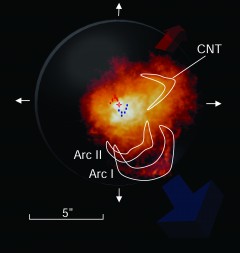
Figure 4. Jets of molecules, indicated by red and blue arrows, flow from VY Canis Majoris photographed by the Hubble Space Telescope. The blue arrow (lower right) shows the slight deviation of the "squirt" flow from the direction towards us. The curved nebulous tail (CNT) and red arrow (upper right) show the fan of material flowing away from us and to the side. The white arrows and transparent circle show the general spherical flow of matter outward. Credit: UA Steward Observatory.
VY Canis Majoris is a red hypergiant star that is one of the largest and most luminous known stars in the Milky Way Galaxy. It is an irregular pulsating variable and lies about 5,000 light-years away in the constellation Canis Major.
Although VY Can is about half a million times as luminous as the Sun, much of its visible light is absorbed by a large, asymmetric cloud of dust particles, about 300 billion kilometers across, which has been ejected from the star in various outbursts over the past 1,000 years or so. The infrared emission from this dust cloud makes VY Can one of the brightest objects in the sky at wavelengths of 5–20 microns.
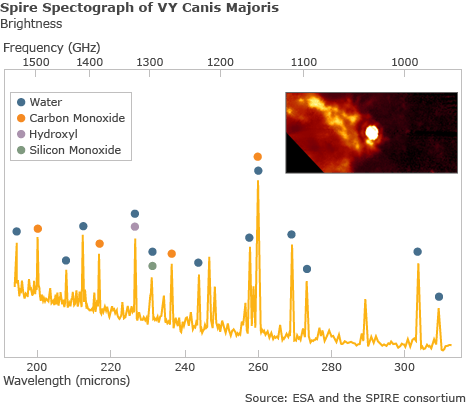
In 2007, a team of astronomers using the 10-meter radio dish on Mount Graham, in Arizona, found that VY Can's extended circumstellar cloud is a prolific molecule-making factory. Among the radio emissions identified were those of hydrogen cyanide (HCN), silicon monoxide (SiO), sodium chloride (NaCl) and a molecule, phosphorus nitride (PN), in which a phosphorus atom and a nitrogen atom are bound together. Phosphorus-bearing molecules are of particular interest to astrobiologists because phosphorus is relatively rare in the universe, yet it is a key ingredient in molecules that are central to life as we know it, including the nuclei acids DNA and RNA and the energy-storage molecule, ATP.
| visual magnitude | 7.4–9.6 |
| absolute magnitude | -9.4 |
| spectral type | M3Ie–4Ie |
| luminosity | 500,000 Lsun |
| radius | 1,800–2,100 Rsun |
| mass | 30–40 Msun |
| distance | 5,000 light-years (1,500 pc) |
| position | RA 07h 22m 59s, Dec -25° 46' 02" |
| other designations | HD 58061, HIP 35793 |

