
Venera
Venera was a series of Soviet probes designed to fly by, orbit, and land on Venus. The Venera spacecraft, unlike the Soviet Mars probes, were tremendously successful, and made the first soft landings on and sent back the first pictures from the surface of Venus.
 |
| Venera 1
|
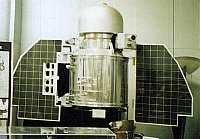
Venera 1
The first spacecraft to fly past Venus; however, all contact with the probe was lost just seven days after launch, when it was about 2 million kilometers from Earth. After its remote Venusian rendezvous, Venera 1 went into orbit around the Sun. Note: the first successful Venus probe was Mariner 2.
Venera 2
Like its predecessor, a flyby mission that suffered a communications breakdown long before its arrival at the second planet. Note: the first spacecraft in the Zond series was actually the second Soviet probe launched toward Venus and it too was lost.
Venera 3
The first attempted landing on Venus. The entry vehicle carried science instruments and medallions bearing the Soviet emblem. However, communication with the probe was lost during descent through the crushing Venusian atmosphere.
 |
| Venera 4
|
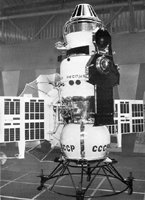
Venera 4
The first probe successfully to send back information during its parachute descent through the atmosphere of Venus.
Venera 5 and 6
Twin spacecraft similar to Venera 4 but of stronger design. Each deployed a 405-kilogram descent probe that sent back information about the atmosphere for about 50 minutes. Each also carried a medallion bearing the Soviet emblem and a bas relief of Lenin to the night side of Venus but failed to transmit from the surface.
Venera 7
The first probe to return data after landing on another planet. Following aerodynamic braking and deployment of its parachute system, Venera 7 extended its antenna and transmitted for 35 minutes during its descent and a further 23 minutes of very weak signals from the surface.
Venera 8
The second successful Venus lander. Venera 8 slowed from 41,696 kilometers per hour to about 900 kilometers per hour by aerobraking, then opened its 2.5-meter-diameter parachute at an altitude of 60 kilometers, and transmitted data during its descent. A refrigeration system cooled the interior components and enabled signals to be sent back for 50 minutes after landing. The probe confirmed Venera 7's data on the high surface temperature and pressure, and also determined that the light level was suitable for surface photography, being similar to the illumination on an overcast day on Earth.
 |
| Venera 9
|
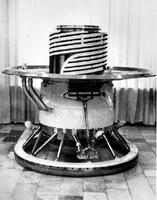
Venera 9 and 10
A pair of identical spacecraft, each consisting of an orbiter and a lander. After separation of the lander, the orbiter spacecraft entered orbit around Venus, studied the upper clouds and atmosphere, and served as a communications relay for the lander. Each lander was slowed down sequentially by protective hemispheric shells, three parachutes, a disk-shaped drag brake, and a compressible, metal, doughnut-shaped, landing cushion. Each sent back data from the surface for 53 minutes and 65 minutes, respectively, from locations about 2,200 kilometers apart and became the first probes to transmit black and white pictures from the Venusian surface. Full 360° shots were not returned, however, because on each probe one of two camera covers failed to come off, restricting the field of view to a half-circle.
Venera 11 and 12
A two-spacecraft mission, each craft consisting of a flight platform and a lander. After ejection of their landers, the flight platforms flew past Venus, serving as data relays for over an hour and a half until they traveled out of range to continue their investigations of interplanetary space. The Venera 12 flyby bus successfully used its Soviet-French ultraviolet spectrometer to observe Comet Bradfield in February 1980. Both Venera 11 and 12 landers failed to return color TV views of the surface and perform soil analysis experiments as planned. All of the camera protective covers failed to eject after landing and the soil drilling experiments were damaged by exposure to the high Venusian atmospheric pressure. Results reported included evidence of lightning and thunder, and the discovery of carbon monoxide at low altitudes.
 |
| Venera 13
|
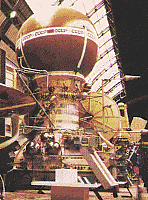
Venera 13 and 14
Identical orbiter/landers launched within the same week. The landing probes touched down 950 kilometers apart to the northeast and east, respectively, of an elevated basaltic plain known as Phoebe Regio. Venera 13 became the first spacecraft to remotely analyze the Venusian surface. Its mechanical drilling arm obtained a sample, which was deposited in a hermetically sealed chamber and maintained at 30°C and a pressure of about 0.05 atmosphere. The makeup of the sample, as determined by the X-ray fluorescence spectrometer, appeared similar to that of oceanic basalts on Earth. Venera 14's attempt at surface analysis was foiled when its drilling arm landed on one of the ejected camera covers.
Venera 15 and 16
A two-spacecraft mission that used side-looking radar mappers to study the surface properties of Venus. The two probes entered nearly polar orbits around Venus a day apart with their orbital planes inclined about 4° apart. This made it possible to reimage an area if necessary. Over their eights months of operation, the spacecraft mapped the area from the north pole down to about 30° N latitude.
| spacecraft | launch date | launch vehicle | arrival date | closest approach (km) | mass (kg) |
| Venera 1 | Feb 12, 1961 | Molniya | May 19, 1961 | 100,000 | 644 |
| Venera 2 | Nov 12, 1965 | Molniya-M | Feb 27, 1966 | 24,000 | 962 |
| Venera 3 | Nov 16, 1965 | Molniya-M | Mar 1, 1966 | landed | 958 |
| Venera 4 | Jun 12, 1967 | Molniya-M | Oct 18, 1967 | landed | 1,104 |
| Venera 5 | Jan 5, 1969 | Molniya-M | May 16, 1969 | landed | 1,128 |
| Venera 6 | Jan 10, 1969 | Molniya-M | May 17, 1969 | landed | 1,128 |
| Venera 7 | Aug 17, 1970 | Molniya-M | Dec 15, 1970 | landed | 1,180 |
| Venera 8 | Mar 27, 1972 | Molniya-M | Jul 22, 1972 | landed | 1,180 |
| Venera 9 | Jun 8, 1975 | Proton | Oct 21, 1975 | landed | 4,936 |
| Venera 10 | Jun 14, 1975 | Proton | Oct 25, 1975 | landed | 5,033 |
| Venera 11 | Sep 9, 1978 | Proton | Dec 21, 1978 | landed | 4,715 |
| Venera 12 | Sep 14, 1978 | Proton | Dec 25, 1978 | landed | 4,715 |
| Venera 13 | Oct 30, 1981 | Proton | Mar 1, 1982 | landed | 4,500 |
| Venera 14 | Nov 4, 1981 | Proton | Mar 5, 1982 | landed | 4,000 |
| Venera 15 | Jun 2, 1983 | Proton | Oct 10, 1983 | orbit | 4,000 |
| Venera 16 | Jun 7, 1983 | Proton | Oct 14, 1983 | orbit | 4,000 |

