
Venus Express
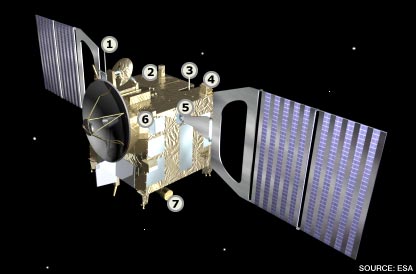
1. MAG:
Magnetometer – measures magnetic, field strength and direction.
2. Virtis:
(Visible and Infrared Thermal Imaging Spectrometer)imaging spectrometer
that operates in the near ultraviolet, visible and infrared parts
of the electromagnetic spectrum.
3. Planetary Fourier
Spectrometer – measures atmospheric temperature
and concentration of known and unknown minor atmospheric constituents
4. Spicav/Soir (Spectroscopy for Investigation of Characteristics of the Atmosphere
of Venus) Imaging spectrometer which detects ultraviolet and infrared
radiation. Soir (Solar Occultation at Infrared) will observe the
Sun through Venus's atmosphere at infrared wavelengths
5. VMC wide angle camera which captures ultraviolet, visible and near
infrared images.
6. VeRa (Venus Radio science) Radio-sounding experiment which will examine
the ionosphere, atmosphere and surface of Venus by means of radio
waves transmitted from the spacecraft.
7. Aspera (Analyzer of Space Plasmas and Energetic Atoms) will study energetic
neutral atoms (ENAs), ions and electrons in Venus' atmosphere.
Venus Express was the first European Space Agency probe to visit the planet Venus. Venus Express was successfully launched on 9 November 2005, by a Soyuz-Fregat rocket from Baikonur Cosmodrome in Kazakhstan. Its journey through space lasted 153 days. Once it was captured by Venusian gravity, in April 2006, Venus Express took 5 days to maneuver into its operating orbit, looping around the poles of the planet. At its closest, it reaches an altitude of 250 kilometers (160 miles) and at its furthest, it is be 66,000 kilometers (41,000 miles) away. The 1,250-kilogram (2,760-pound) spacecraft will orbit Venus on a nominal 500-day mission.
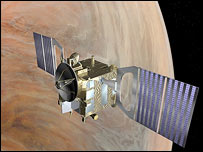 |
| Venus Express will explore the planet from a long,
elliptical orbit, at times swooping as close as 250 km to the Venusian
surface. Image: ESA
|
The Venus Express payload of 7 instruments comprises a combination of spectrometers, spectro-imagers and imagers covering a wavelength range from ultraviolet to thermal infrared, a plasma analyzer and a magnetometer. These instruments will enable a detailed study of the planet's atmosphere, plasma environment, and surface.

