
Viking labeled release (LR) experiment
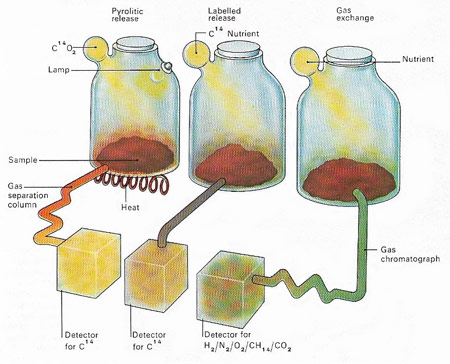
Figure 1. Each Viking lander had an automatic biology laboratory to which soil samples were delivered by a mechanical scoop in three experiments: Pyrolytic Release was designed to detect any microorganisms that live by photosynthesis, taking carbon dioxide, and using it to make organic matter in artificial sunlight (lamp). Labelled Release looked for signs of metabolism, evidence that organisms in the soil were maintaining and reproducing themselves. Gas Exchange looked for any exchange of gases between microbes in the soil and atmosphere of the chamber.
The Viking labeled release (LR) experiment was one of three biology experiments carried aboard each of the Viking landers (Figure 1).
 |
Originally known as "Gulliver";1 the labeled release (LR) experiment was developed by Gilbert Levin and designed to detect carbon dioxide released by microorganisms as a result of their metabolic activity.2 On Earth, this would be classed as a respiration experiment. A sample of soil was placed inside a culture chamber and a broth of 7 organic nutrients (formate, glycolate, glycine, D-alanine, L-alanine, D-lactate, and L-lactate), labeled with radioactive carbon-14, allowed to drip onto it. If microbes were present in the sample, it was assumed they would metabolize the organic compounds in the nutrient and release radioactive carbon dioxide which would be trapped on a chemically coated film at the window of a Geiger counter. The LR experiment had the virtue of being able to detect growth, as well as metabolism, since the rate of carbon dioxide production would increase exponentially with a growing culture. Like the Viking gas exchange (GEX) experiment, however, it assumed that Martian microbes would be (a) activated by liquid water (which might not be true since any organisms on Mars might have adapted to a completely waterless environment), and (b) able to metabolize the same organic nutrients as terrestrial organisms (whereas, in fact, such Earthly foodstuffs might be toxic to life based on a different biochemistry). These drawbacks were avoided by the Viking pyrolytic release (PR) experiment.
References
1. Levin, G. V., Heim, A. H., Clendenning, J. R., and Thompson, M.-F.
"'Gulliver' - A Quest for Life on Mars," Science, 138,
114 (1962)
2. Levin, G. V. "Detection of Metabolically Produced Labeled Gas: TheViking
Mars Lander," Icarus, 16, 153 (1972).
