
ventilation
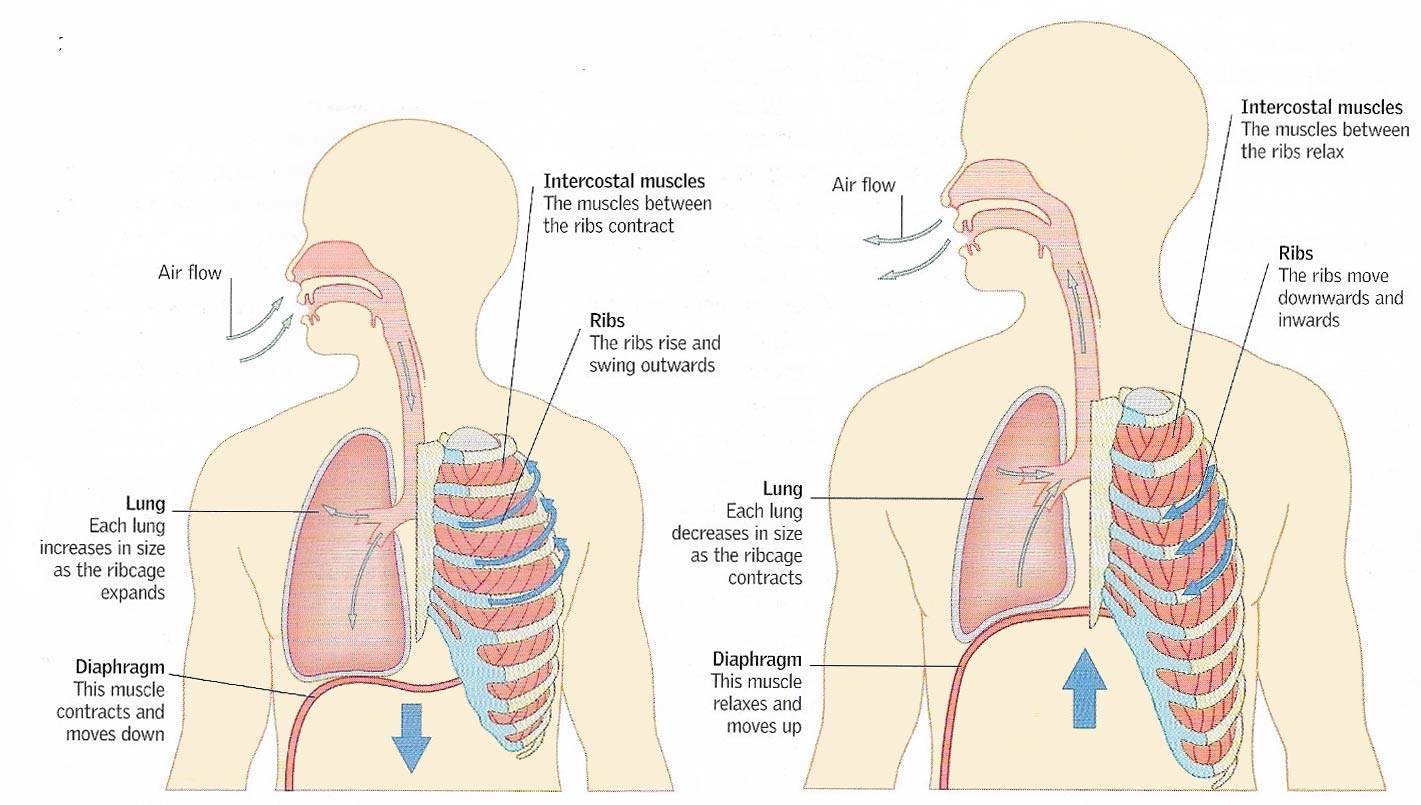
During breathing, air moves from areas of high pressure to areas of low pressure. When the pressure in the lungs is lower than the pressure in the atmosphere, air enters the airways. If the pressure in the lungs increases, air moves out of the lungs and is then exhaled. (Left) Inhaltion: the diaphragm and intercostal muscles between the ribs contract. As a result, the ribcage expands, creating a decrease in pressure, and air is drawn into the lungs. (Right) Exhalation: after breathing in, the diaphragm and intercostal muscles relax and the ribcage contracts. Pressure inside the lungs increases and air moves out of the lungs in order to be exhaled.
Ventilation, also known as external respiration (see respiration), is the movement of air through the conducting passages between the atmosphere and the lungs. The air moves through the passages because of pressure gradients that are produced by contraction of the diaphragm and thoracic muscles.
Pulmonary ventilation
Commonly referred to as breathing, the process of air flowing into the lungs during inspiration (inhalation) and out of the lungs during expiration (exhalation). Air flows because of pressure differences between the atmosphere and the gases inside the lungs.
Air, like other gases, flows from a region with higher pressure to a region with lower pressure. Muscular breathing movements and recoil of elastic tissues create the changes in pressure that result in ventilation. Pulmonary ventilation involves three different pressures:
Atmospheric pressure is the pressure of the air outside the body. Intraalveolar pressure is the pressure inside the alveoli of the lungs. Intrapleural pressure is the pressure within the pleural cavity. These three pressures are responsible for pulmonary ventilation.
Inspiration
Also known as inhalation, the process of taking air into the lungs. It is the active phase of ventilation because it is the result of muscle contraction. During inspiration, the diaphragm contracts and the thoracic cavity increases in volume. This decreases the intraalveolar pressure so that air flows into the lungs. Inspiration draws air into the lungs.
Expiration
Also known as exhalation, the process of letting air out of the lungs during the breathing cycle. During expiration, the relaxation of the diaphragm and elastic recoil of tissue decreases the thoracic volume and increases the intraalveolar pressure. Expiration pushes air out of the lungs.
Movements in breathing
Throughout life, the movements of the thoracic wall produce the alterations in the size of the thoracic cavity which are essential for respiration. During inspiration – that is, when a breath is taken – the cavity is enlarged; during expiration the cavity is diminished. As the cavity of the thorax enlarges, atmospheric pressure forces air through the air-passages into the lungs, enlarging them at the same rate, so that they fully occupy the expanding space. As the cavity diminishes, the air is forced out again.
There are two types of respiration: thoracic and abdominal. In thoracic inspiration, the sternum and the anterior parts of the ribs move upwards and forwards, with the result that the anteroposterior diameters of the thoracic cavity are increased. At the same time, on account of the peculiarities of the articulations of the ribs, the lower borders of the majority of the ribs rotate outwards, and the transverse diameter of the cavity is thus enlarged. In thoracic inspiration, the cavity of the thorax is increased therefore both antero-posteriorly and transversely.
In abdominal inspiration, the vertical diameters of the thoracic cavity are increased by the contraction and descent of the diaphragm. As the muscular, peripheral parts of the diaphragm contract, they pass from a more curved to a less curved form, and press down the contents of the abdomen so that the abdominal wall bulges forwards. The pleural cavities are thus increased in height, and at the same time the diaphragm as a whole descends, and the organs in the mediastinum (the central partition of the thorax) become markedly elongated and narrowed.
When the contraction of the muscles which raise the ribs and sternum ceases, thoracic expiration begins. The weight of the thoracic wall, the resilience of the costal cartilages, and the elasticity of the ligaments reduce the cavity to its original size; and air is expelled from the lungs. Similarly, in abdominal expiration, when the diaphragm ceases to contract, the abdominal contents are pressed upwards by the recoil of the muscles of the abdominal wall; the height of the thoracic cavity is thus reduced, and air again is expelled.
Abdominal and thoracic respiration are initiated and controlled by different groups of muscles, and they may take place independently of each other or be combined. It is commonly stated that abdominal respiration predominates in the male, and thoracic in the female; and it will be readily understood why respiratory movements in the female become almost wholly thoracic in the later months of pregnancy.
Ventilation mechanisms
More generally, ventilation is the process by which air or water is taken into and expelled from the body of an animal and passed over a surface across which gas exchange takes place. Ventilation mechanisms including breathing, as described above, by which air is drawn into the lungs for gas exchange across the walls of the alveoli; the movements of the floor of a fish's mouth, coupled with those of its gill covers, which draw water across the gills; and the pumping movements of the abdomen of some insects, which draw through spiracles that carry it to the tissues.

