
volcanic gas
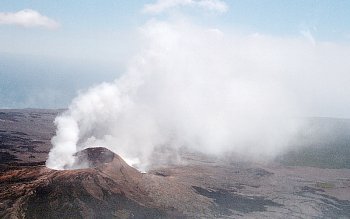
Sulfur dioxide and other volcanic gases rise from the Pu'u O'o vent on Kilauea Volcano, Hawai'i. During periods of sustained eruption from Pu`u O'o between 1986 and 2000, Kilauea emitted about 2,000 to 1,000 metric tonnes of irritating sulfur dioxide each day. Credit: K. A. McGee / US Geological Survey.
Magma contains dissolved gases that are released into the atmosphere during eruptions. Gases are also released from magma that either remains below ground (for example, as an intrusion) or rises toward the surface. In such cases, gases may escape continuously into the atmosphere from the soil, volcanic vents, fumaroles, and hydrothermal systems.
The most common gas released by magma is steam (H2O), followed by CO2 (carbon dioxide), SO2 (sulfur dioxide), (HCl) hydrogen chloride, and other compounds.

