
weight
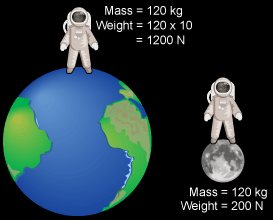
Weight is the force exerted on an object with mass by a gravitational field, such as that of a planet. Weight is experienced as a reaction to this force against a solid surface. Although the mass of an object is independent of location, its weight varies depending on the strength of the local gravitational field.
Weight is given by the product of mass (m) and the acceleration due to gravity (g), that is: W = mg. Use the table below to figure out how much you woulld weigh on another planet of the solar system or the Moon: simply multiply your weight by the conversion factor. (Note: The gas giants, Jupiter, Saturn, Uranus, Neptune, don't have solid surfaces, so the values shown pretend that they do.)
| Weight on other worlds | ||
|---|---|---|
| place | vonversion factor | weight of a person whose mass is 60 kg (132 lb) on Earth |
| Moon | × 0.166 | 99.6 N |
| Mercury | × 0.378 | 226.8 N |
| Venus | × 0.907 | 544.2 N |
| Earth | - | 600 N |
| Mars | × 0.377 | 226.2 N |
| Jupiter | × 2.36 | 1416.0 N |
| Saturn | × 0.916 | 549.6 N |
| Uranus | × 0.889 | 533.4 N |
| Neptune | × 1.12 | 672.0 N |
| Pluto | × 0.059 | 35.4 N |
Weightlessness
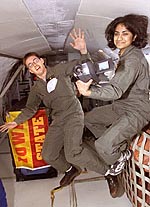
Weightlessness is the condition of zero-gravity (zero-g) or microgravity (near-weightlessness) experienced by all spacecraft and their occupants when in orbit, in any other state of free fall, or traveling through space at constant speed. Weightlessness can be of great benefit in certain areas of research and manufacturing, and large construction work in space. Large masses in orbit do not require support, and their movement is restricted only by inertia. Structures can be designed without provision for support against the forces of gravity – in free space there is no such thing as a static load. On the other hand, long-term exposure to weightlessness has adverse health effects, including muscular deconditioning and bone demineralization.
 |
The first person to write about the possibility of weightlessness may have been Bishop Francis Godwin in his book The Man in the Moone (1638).

